Starting an RV detailing business: what I wish I knew
By Hector Salas · October 21, 2026
Who actually pays for an RV detailing business
I get asked a lot who actually pays for an RV detailing business, and the answer is not who you think.
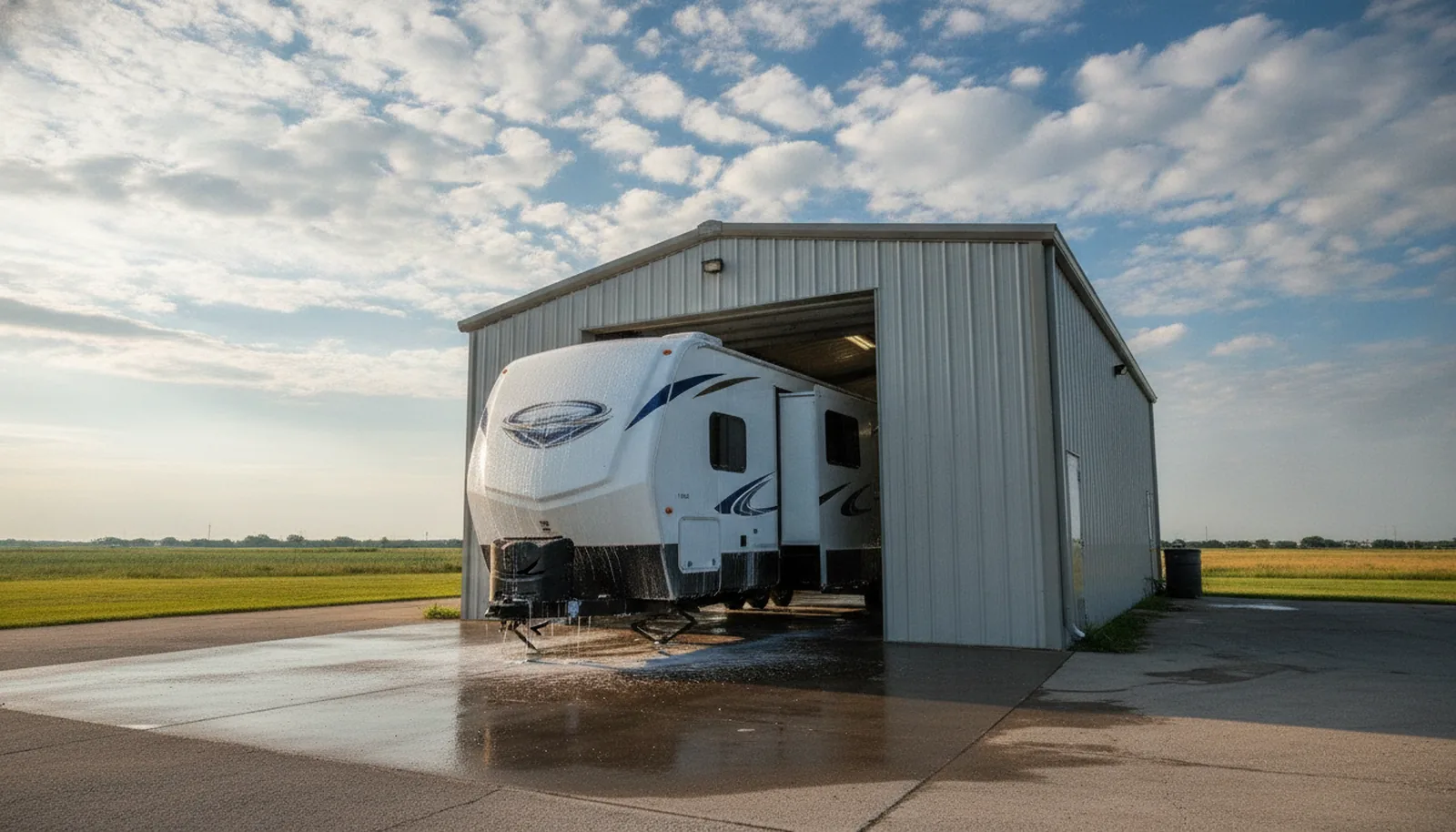
I started the bay in April 2022. First month I detailed three rigs and lost money on two, all while a 38-foot Class A dripped black-streak water onto my brand new slab. Eleven grand for that door and the lift and the reclaim mat, and I still hadn’t figured out per-foot pricing. If you’ve been looking at mobile RV detailers in Colorado Springs to see what other guys charge, I was cheaper than all of them and broke.
Four types walk into my bay. Snowbirds headed south, full-timers who live in the rig, people selling a rig they haven’t washed in two years, and dealers who need inventory showroom-clean. The sellers will pay for oxidation removal and a wax because a chalky roof kills resale. Full-timers are frequent but they watch every dollar.
Equipment categories that matter
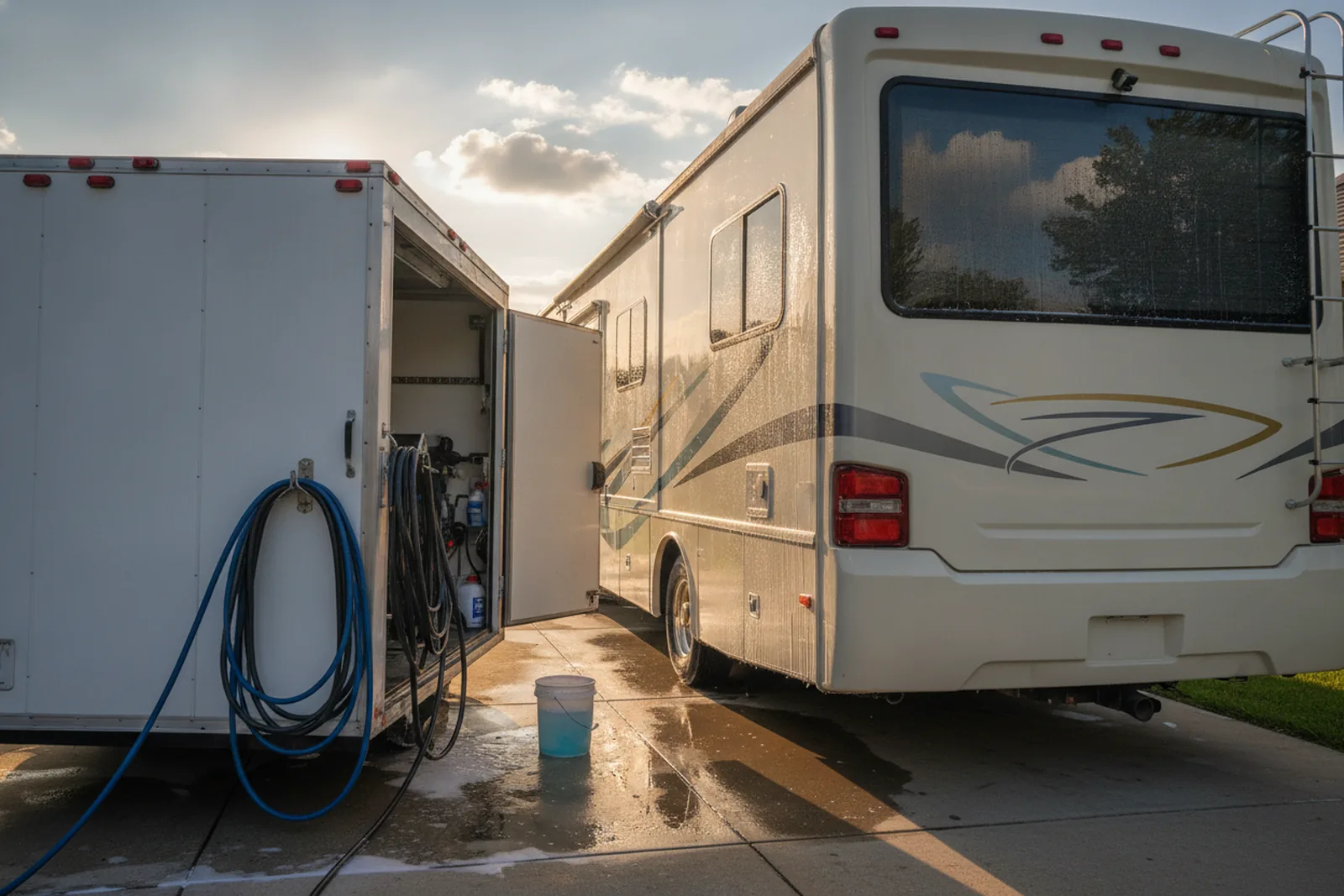
The real question is water, power, and runoff, and a bay answers all three differently than a mobile rig does. Mobile guys carry a 100-gallon tank or use the customer’s spigot. A bay needs a supply line and a drain that meets city rules. Electric pressure washers pull 15 amps, so a generator or a 20-amp circuit is non-negotiable.
Here’s the startup comparison I wish someone had shown me befor I poured concrete:
| Item | Mobile setup | Fixed shop bay |
|---|---|---|
| Door height | Any parking lot | 14-foot minimum |
| Water | Carry or customer’s spigot | 3/4-inch supply, city drain |
| Power | 3,000-watt generator or shore line | Two 20-amp circuits |
| Runoff | Berms, drain covers, vacuum | Reclaim mat, oil/water separator |
| Roof access | Folding ladder | Rolling platform |
| Startup friction | Low, but Park managers ask questions | Permits, zoning, slab |
A bay buys you year-round work, but that slab in Kansas heat cracks if you don’t pour it thick enough. Ask me how I know.
An RV detailing business lives and dies by per-foot pricing
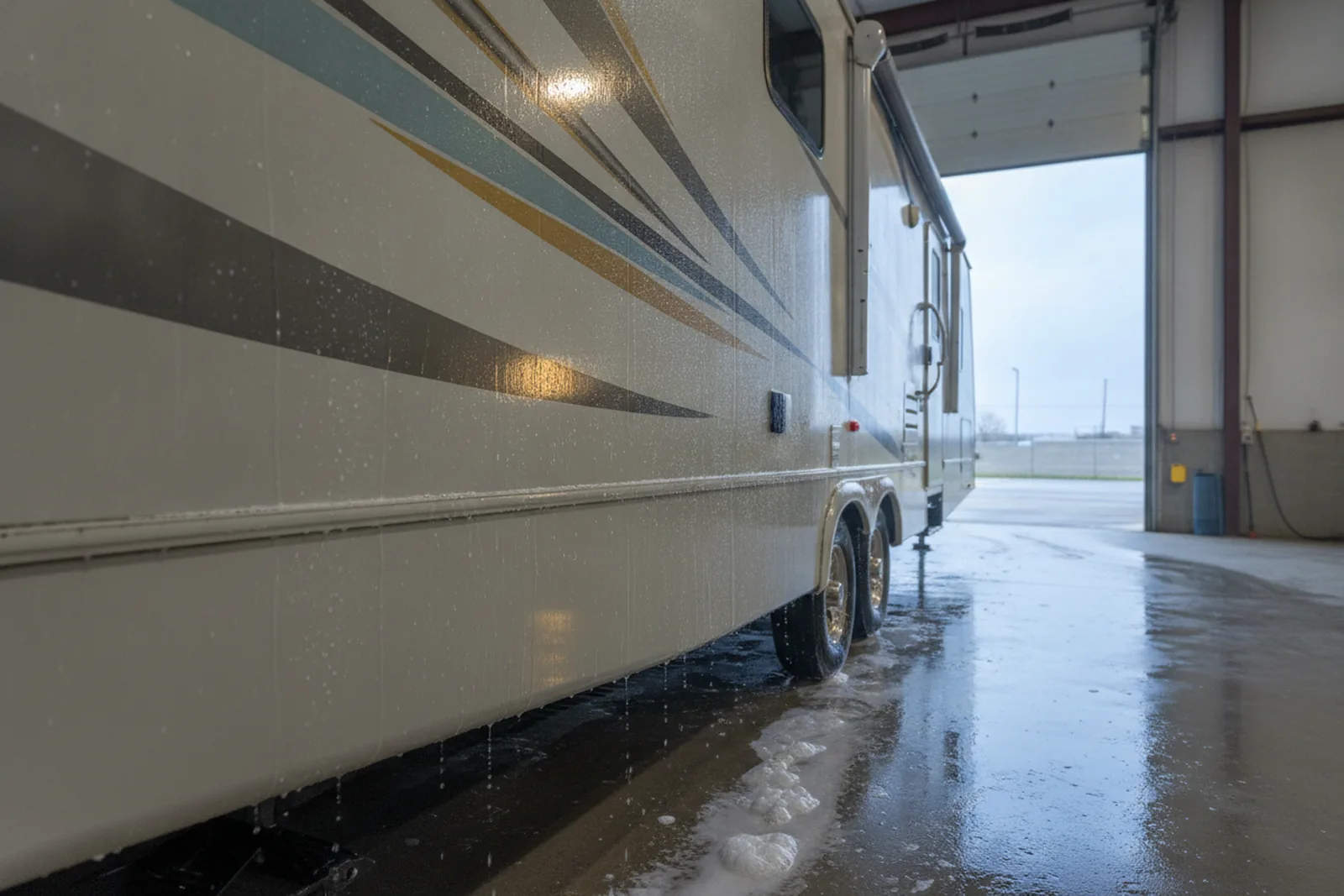
The industry norm is a per-linear-foot quote, and the spread is wild. A wash-only lands between $3 and $5 a foot. Add wax and you’re at $10 to $16. Oxidation removal runs $15 a foot for light chalk to $30 and up for real correction. Ceramic coatings start around $24 a foot and climb past $100 with prep.
My first season I charged $12 a foot for wash and wax and averaged 2.5 hours on a 30-foot trailer. That’s forty-five dollars an hour before chemicals and generator fuel. Then a 34-foot motorhome took me nine hours and I billed $1,100. I point to that job when peopel ask if mobile RV detailers nationwide are worth the price.
I wish I’d watched this before setting my first per-foot prices. It breaks down the numbers better than I can here.
Licenses, insurance, and the rules nobody tells you about
You need garagekeepers coverage before you touch a customer’s rig, because your standard general liability policy excludes damage to the rig while its in your care. I pay $1,800 a year for general liability with garagekeepers coverage. Check your city,your county, and your HOA before you spray a rig anywhere.
Roof falls are the real killer. I know a guy in Tulsa who stepped through a skylight and broke his leg in three places. In the south, heat stroke takes down more detailers than ladders. I start at 6 a.m. In July and I still drink a gallon before noon.
Water and runoff rules change by city and by park
Call ahead, because the rules are not the same two towns over. Federal stormwater regulations push cities to ban soapy discharge into storm drains, but residential car washing is often exempt, so towns patch the gap with their own rules. Wichita wants mobile detailers to use a berm and vacuum up the wastewater. A campground near El Dorado Lake bans all RV washing on site.
Many RV parks require vendor approval before you can work in their lot. Some charge a wash fee, which can vary. Some make you show insurance. I keep a binder in the truck with my COI, my stormwater plan, and a picture of my water-reclaim setup. It opens more doors than a discount coupon.
Seasonality, storage lots, and the winter survival plan
In Kansas, April through September is the rush and then October falls off a cliff. November and December bring storage-lot calls from owners who forgot to wash before parking. January through March is dead unless you’ve got a bay. I built the bay because I couldn’t lay off my one employee every winter and expect him back in spring.
Detailers in Phoenix and Tucson run opposite. Summer is slow, October through April is booked. That’s why the per-foot prices are higher down there. They’re charging for sun protection as much as soap. If your mobile, map your season now and line up storage-lot contracts for the dark months. Forty rigs at a modest per-wash price in November can beat one big ceramic job in March, because the ceramic job is one day and the forty washes are three weaks of payroll.
The coating promise you can’t keep
I sell two ceramic coatings, and neither one is forever. A spray sealant rated for about a year and a full coating rated for about two years. I never quote beyond that. Solar UV, road salt, and tree sap will shorten any coating’s life on a rig that sits outside. The coating makers’ warranties cover failure of the coating itself, not scratches or neglect, and they make you jump thru hoops: registration within thirty days, annual inspections, approved washers only. I hand every customer the warranty card and tell them to read the exclusions before they sign.
That honesty costs me the occasional upsell, but it keeps Google reviews from saying I promised five years of shine and delivered eighteen months. We wrote a guide on detailing an RV before selling that says the same thing: oxidation removal first, coating second. You cant seal chalk.
Why a bay gives you use
A bay is the difference between running a business and owning a job. A mobile rig can chase the snowbirds and park managers all year. A bay traps you in one city, but it lets you work in rain, wind, and 100 degrees without laying a tarp. I spent a good chunk of change on my bay build in 2020, including the 14-foot door and a lift. It paid for itself in eleven months of coating jobs alone.
Mobile guys have lower fixed costs and can underbid you on a wash. You have to win on speed and outcome. I can do a 32-foot travel trailer wash and wax in about four hours under a roof, no sun, no water spots. Ask a mobile detailer to match that in August. And if you’re a customer reading this and wondering whether shelling out for a bay-detailed job is worth it, start with our honest look at whether professional RV detailing pays off.
What I’d do differently in year one
I’d skip the bay and start with a partner who owns a pressure washer and a truck, split the generator cost, and spend the first six months chasing storage lots instead of retail customers. Storage lots are ugly money and no one argues about a $40 wash. Then I’d rent a bay one day a week before I ever committed to a fixed location.
This weekend, run the numbers on your own rig: length times a typical per-foot wash-and-wax rate, length times a typical per-foot oxidation correction rate. Then call two detailers, one mobile and one with a bay, and ask for a written per-foot quote on the same work. The diffrence will teach you more then any forum thread.
More from the wash bay
FAQ
How much does it cost to start an RV detailing business?
You can start mobile for a few thousand dollars if you use the customer's water and power and buy a mid-range pressure washer and a polisher. A fixed bay with a 14-foot door, plumbing, and a lift will run several tens of thousands depending on your location. Get a detailed quote from a local equipment supplier before you commit.
How much should I charge per foot for RV detailing?
Wash-only runs about $3 to $5 per foot. Wash and wax runs $10 to $16 per foot. Oxidation removal runs $15 to $30 per foot and up. Ceramic coatings range from $24 to over $100 per foot. Region, rig size, and condition move the price. Always inspect before quoting.
Do I need special insurance to detail RVs?
Yes. Your general liability policy likely excludes damage to customer property in your care, custody, or control. You need garagekeepers coverage to cover the rig itself while you work on it. Call a commercial insurance agent and be specific about RVs.
Can I wash RVs at an RV park?
Sometimes. Many parks ban washing, require office approval, charge a wash fee, or require a shutoff nozzle. Some require proof of insurance. Always ask the office before you put a sponge on a rig. City stormwater rules also apply.
How do I handle wastewater and runoff when mobile detailing?
Check your city's rules first. Common practices are berms, drain covers, and wet vacuums to capture wash water and either discharge it to a sanitary sewer or recycle it. Never let soapy water run into a storm drain.
Is a ceramic coating worth offering?
It's a high-ticket upsell, but don't overpromise durability. Offer correction first, then a coating with a written warranty that specifies lifespan and maintenance. Read the fine print: many warranties require annual inspections and approved washing.
What's the biggest safety risk for an RV detailer?
Falls from roofs and ladders. Many RV roofs are not walkable. Use a platform, a walkboard, and a harness if needed. Heat stroke is a close second in hot climates. Start early, drink water, and never rush a roof job.
Find RV detailers near you
Compare RV detailers and mobile washes in your city, then ask a few for a price.
Browse by state