RV Detailing: What a Full Detail Actually Includes
By Hector Salas · October 21, 2026
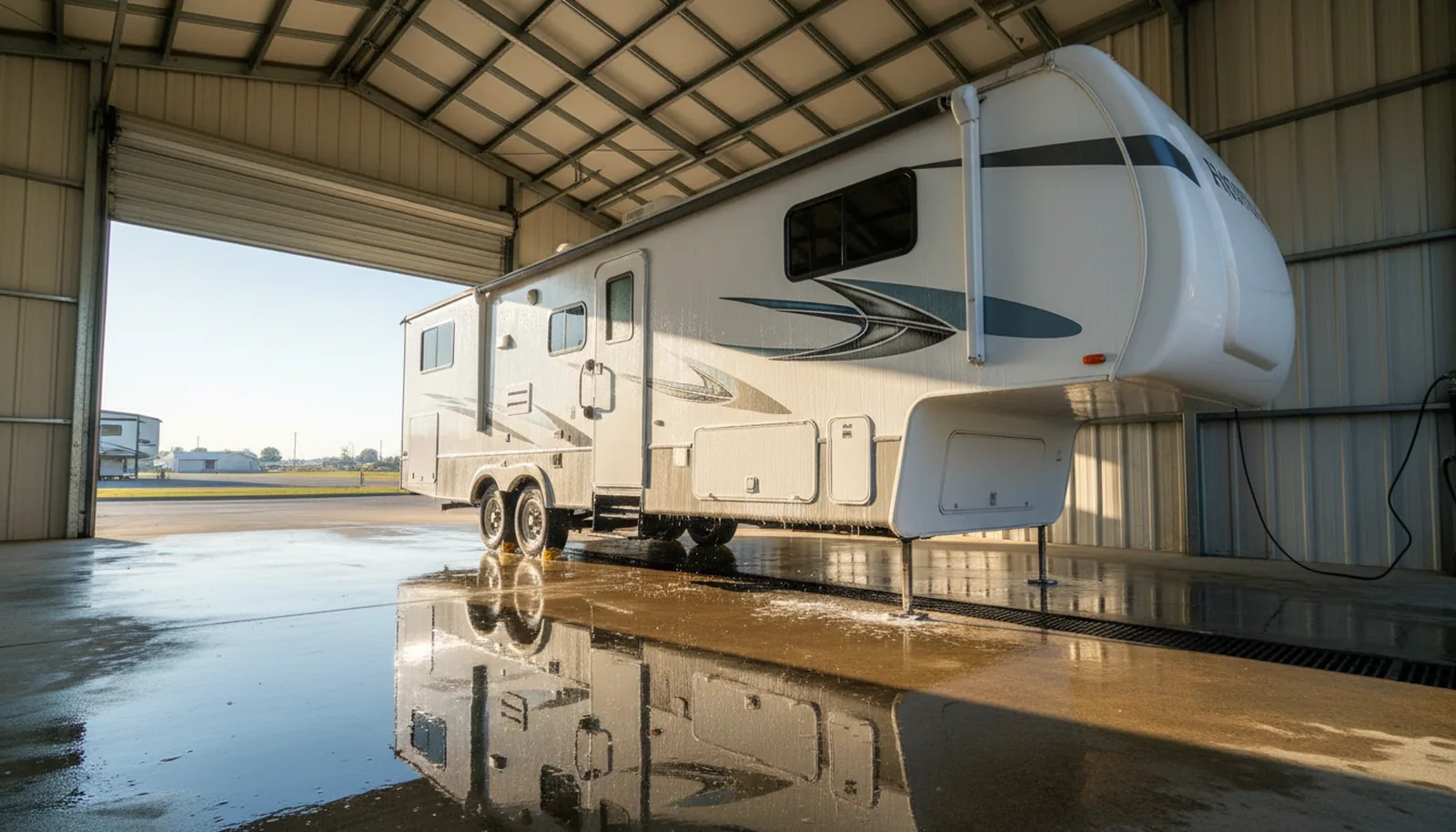
The first fifth wheel that rolled into my new 14-foot bay back in 2020 was a 38-footer, and it taught me why RV owners in Wichita need professional RV detailers. The gelcoat was so dead the owner’s towel came up white when he wiped it. “Just a wash and wax,” he tells me. Four days later I’d compounded and polished every square foot of that thing and handed him a bill that reflected the correction work, not just a wash and wax. He looked at me like I’d set his truck on fire. But that job taught me what RV detailing actually is, and it ain’t a wash. It’s a process: decontaminate, correct, protect. If you’re comparing RV detailers in Wichita, ask them what that process includes in writing. Most won’t volunteer it.
Ive owned a 2020 30-foot travel trailer with one slide-out for three years, and Ive seen hundreds of rigs roll through my shop. They’re not.
Wash vs. detail: what RV detailing means when I quote it
A wash gets the dirt off. A detail includes decontamination, correction where it’s needed, and real protection. You can do a wash in your driveway with a hose, a bucket, and a microfiber mitt, and I’ll be the first to tell you to do it yourself if that’s all you want. Exterior detail means I’m decontaminating the surface, checking for oxidation, correcting what needs correcting, and putting real protection on. Interior is everything inside from vacuum to glass.
Most owners are shocked at the time. On a 30-footer, a safe wash alone is three to four hours. A full exterior detail with light oxidation correction is a day and a half. And if somebody quotes you $10 a foot for a “full detail,” ask what’s included, becuase that’s at the low end of wash-and-wax pricing and likely won’t include correction. You’ll find out when it rains and the water doesn’t bead.
The exterior sequence a pro follows, top to bottom
I start on the roof, always. Then, if the gelcoat is oxidized, I compound and polish. Finally, I protect with wax, sealant, or coating, and dress the trim and tires.
The sequence takes time. Here’s what I did on a customer’s 33-foot Class C: roof, one hour and ten minutes. Main wash, two hours. Clay mitt and spot decon, 40 minutes. Wipe down and dry, 30 minutes. Then sealant, 50 minutes. That’s a full day before any correction. Oxidation removal would add another three to five hours.
Roof cleaning by membrane: EPDM vs TPO vs fiberglass
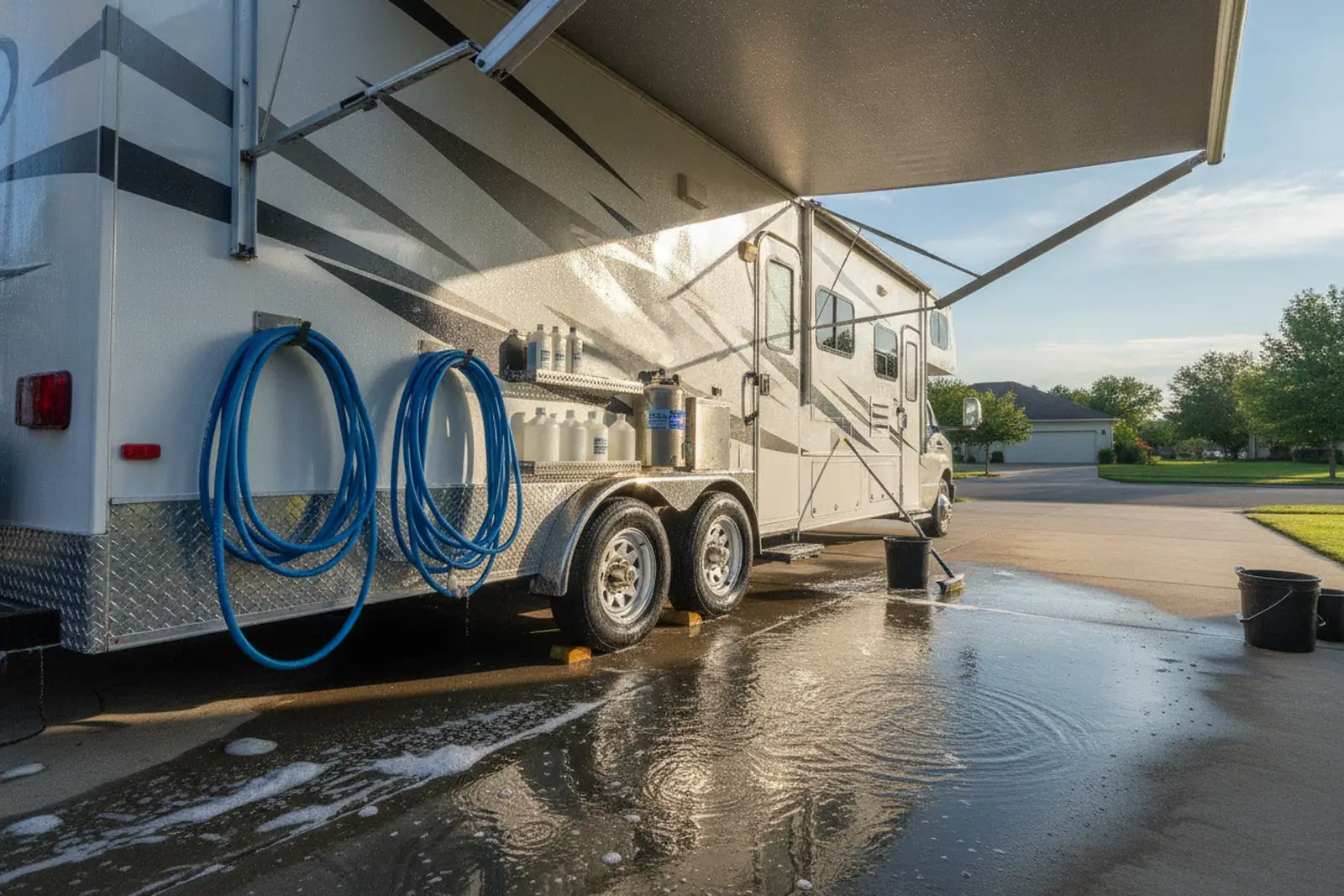
The roof is where I see the most damage from owners using the wrong chemical. EPDM rubber roofs react badly to harsh degreasers and anything with petroleum in it, and I see guys grab a harsh degreaser and go to town, then wonder why the membrane dried out and cracked. I use a cleaner that’s safe for the specific roof membrane, checking the maker’s care sheet first. A flexible brush on a pole, light pressure, lots of water. TPO s similiar, but it’s slicker and holds less dirt, so I use less chemical on it. Fiberglass roofs are gelcoat, so I wash and occasionally wax them, but a waxed roof is slippery, so I warn the customer.
I never pressure-wash a roof membrane. No maker approves it, and forcing water under the lap sealant at the edges is how you get a leak inside a year later. I use a hose and a brush, and it takes longer. If a mobile detailer says he’ll “power wash the roof” as part of the wash, I’d ask him to show me the roof maker’s care sheet first. If he can’t, walk. Comparing RV detailers across Kansas should start with thier roof answer, because it tells you everything about there process.
If you want to see the roof cleaning process in action, check out this complete guide video I often recommend to clients.
Interior detail: vacuum, extraction, glass, odor
Interior is the part I can’t rush. I vacuum everything, then wipe every surface, then hit the upholstery with a mild cleaner and an extractor if it needs it, then glass last. Glass is last because anything I spray earlier ends up on the windows. That’s not a detailer’s trick, that’s just how it works. For odors, I dont mask them; I find the source. Usually it’s the fridge drip pan or a window seal that’s been leaking. If a customer asks for an ozone treatment, I run it only in an empty, closed rig and air it out for hours after, because ozone can damage lungs and materials.
On my own travel trailer, I do this every month, but I still find dust in the window tracks. Kansas wind, what can I tell you. A shop interior detail on a 30-footer takes me about two and a half hours. A deep clean with extraction and odor work can hit five.
Add-ons that are worth it, and one that isn’t
The add-on menu is where detailers make profit, and some of it is waste. Here’s what I’d actually pay for:
- Oxidation removal: expensive but the most important if your gelcoat is chalky. It’s the only way to get the shine back before protecting.
- Ceramic coating: worth it if you plan to keep the rig for years and don’t want to wax as offen, but check the coating’s claimed durability and warranty. But coating over oxidized gelcoat is a mistake; correction comes first.
- Headlight lens restoration: cheap and makes night driving safer on older motorhomes.
- Awning cleaning: usually just mild soap and a soft brush. I’d do it myself.
What I wouldn’t pay for: tire dressing on a travel trailer that sits for weeks. It don’t protect, just shines, and Kansas wind blows dust right onto the wet dressing.
For what you’d pay per foot for these services, see our RV detailing prices post. The spread from wash to full correction is huge, and knowing the bands keeps you from overpaying.
How long a full RV detail takes, by service tier
Time is the honest way to judge a detailer’s price. More hours mean more labor, and labor is 80% of the bill. Here’s what I see on average for a 30-foot rig in fair condition, with one detailer working:
| Service tier | What it includes | Hours on a 30-ft rig |
|---|---|---|
| Wash only | Roof rinse, hand wash, dry | 3 to 4 |
| Wash and wax/sealant | Add decon and one coat of wax or sealant | 6 to 8 |
| Full exterior detail with light oxidation removal | Degrease, decon, compound and polish, sealant | 12 to 16 |
| Full detail, interior and exterior | Everything above plus interior clean, no extraction | 16 to 20 |
These are my ranges, and they vary by condition, height, and whether the detailer has a helper. If someone quotes less than half these hours, ask what they’re skipping. If you want to understand the diffrence between a detailer who comes to your driveway and one with a bay, read our mobile RV detailing vs a shop bay post.
Mistakes I see from owners and detailers
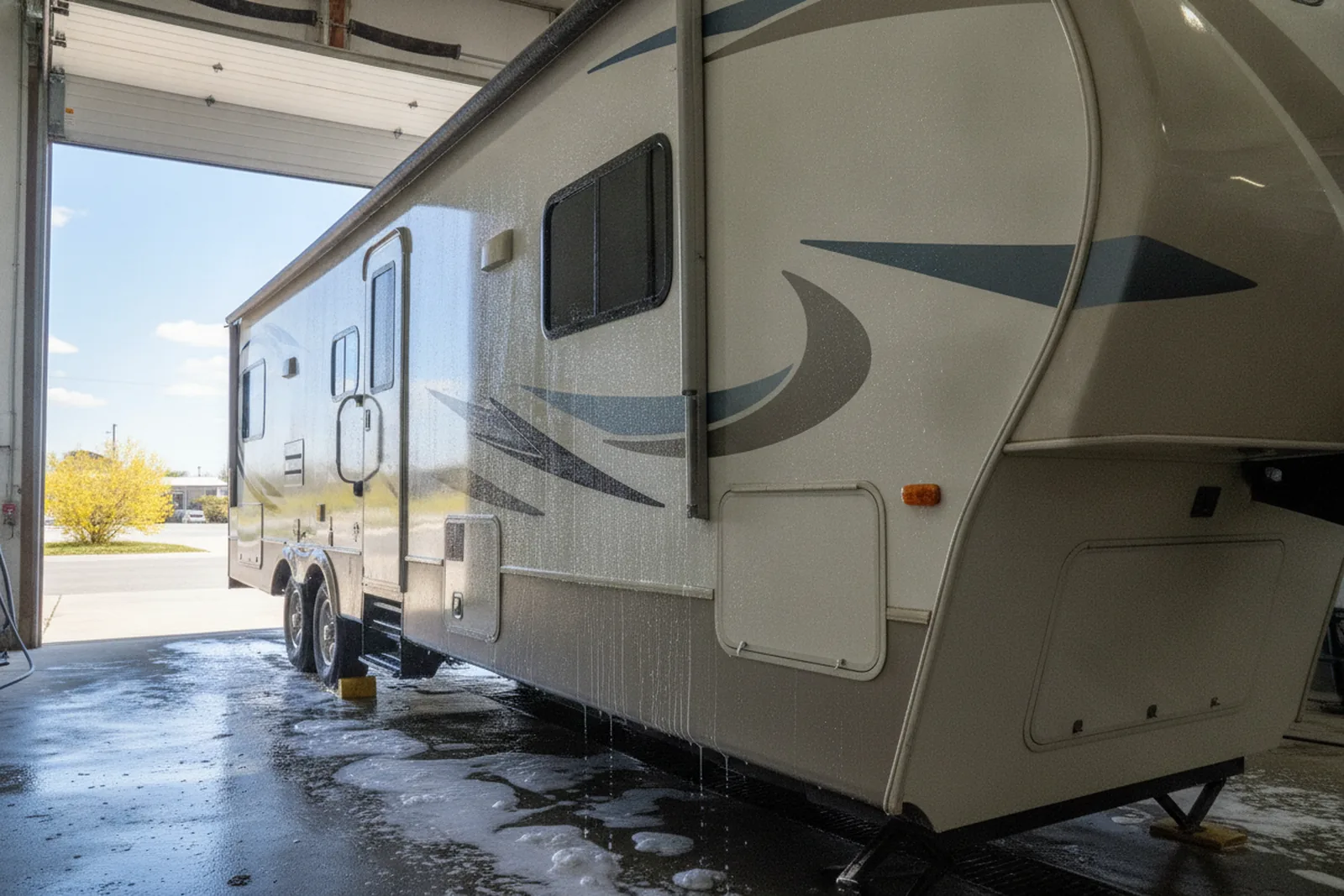
The biggest owner mistake is buying a bottle of compound and going at a clear-coated front cap with a wool pad. Clear coat is not gelcoat, and a rotary buffer will burn through it in seconds. On decals and painted caps, I always do a test spot with the least aggressive polish first. Another mistake: pressure washing too close to window seals, slide-outs, and vents. Water gets forced past the gaskets and into the walls. I use a low-pressure fan tip, never a zero-degree nozzle, and I stay back from anything with a seam.
Detailers make mistakes too. The worst I’ve seen is wax over chalky gelcoat without compounding. The wax seals in the oxidation, and three weeks later the rig is dull again with a haze that’s harder to remove. If a detailer skips the towel test, he doesn’t know what he’s doing. The towel test: wipe a dry section with a clean microfiber. If it comes back with chalk, you need correction, not wax.
What I’d tell a friend buying their first RV detail
Get three quotes, but ask them what the quote includes. I’d want it in writing: roof cleaning method, decon steps, whether correction is compound or just polish, what protection they’ll apply, and how long they think it’ll take. Then compare the hours, not the dollars. A $15-per-foot wash and wax on a 30-footer is $450; a full correction and sealant might run higher, depending on condition and what’s included. Both are fair if the work matches the number.
This weekend, do the towel test on your own rig. If you see chalk, start saving for oxidation removal, because no wax is fixing that. Then pull up mobile RV detailers or shops with an RV bay near you, ask two of them for a written per-foot quote on the same job, and compare what each tier includes. The right detailer will tell you what he’s doing and why, not just hand you a price.
More from the wash bay
FAQ
What's included in a full RV detail?
A full RV detail typically includes exterior wash, roof cleaning, decontamination, polishing or compounding if needed, protection with wax or sealant, and interior vacuum and wipe-down. Some add ceramic coating or oxidation removal. Always get a written list, because detailers define "full" differently.
How much does RV detailing cost per foot?
Prices range widely: a wash is about $3 to $5 per foot; wash and wax $10 to $16; light oxidation removal $15 to $30; ceramic coating $24 to $100 or more. Condition and rig height change the quote. Compare detailers by what the per-foot rate includes, not just the number.
How often should I wax my RV?
Gelcoat sidewall makers say wax once or twice a year, more if stored outside. Synthetic sealants last a bit longer. Ceramic coatings claim anywhere from about six months to several years, with some RV-specific coatings advertised as one- or two-year products. Sun and heat shorten all protection, so check beading after each wash. If water doesn't bead, it's time.
Can I pressure wash my RV?
You can, but carefully. Never use a zero-degree tip, and stay back from window seals, slide-outs, and vents. Decals need low pressure and at least 12 inches of distance. Roof membranes should not be pressure washed at all; use a hose and brush. When in doubt, use a garden hose.
What's the difference between a wash and a detail?
A wash removes surface dirt. A detail includes decontamination, correction of oxidation or swirls, protection with wax or coating, and interior cleaning. Detailing takes much longer and costs more, but it restores the surface and preserves the finish. Think of a wash as maintainance, a detail as restoration.
Is ceramic coating worth it on an RV?
If you keep your rig outside and plan to own it for years, ceramic coating can save waxing time and protect against UV. It can cost anywhere from about $800 to $2,500 or more on a 30-footer, and the surface must be corrected first. Read the warranty: many require annual inspections and approved washing.
How long does a full RV detail take?
For a 30-foot rig, a wash takes 3 to 4 hours; wash and wax 6 to 8; full exterior detail with oxidation removal 12 to 16; full interior and exterior 16 to 20. Mobile detailers with two people can be faster, but time is a good check on price.
Find RV detailers near you
Compare RV detailers and mobile washes in your city, then ask a few for a price.
Browse by stateOr jump to: Mesa, AZ · Reno, NV · Scottsdale, AZ