Mobile RV Detailing vs a Shop Bay: The Honest Trade-Off
By Nate Ferreira · October 21, 2026
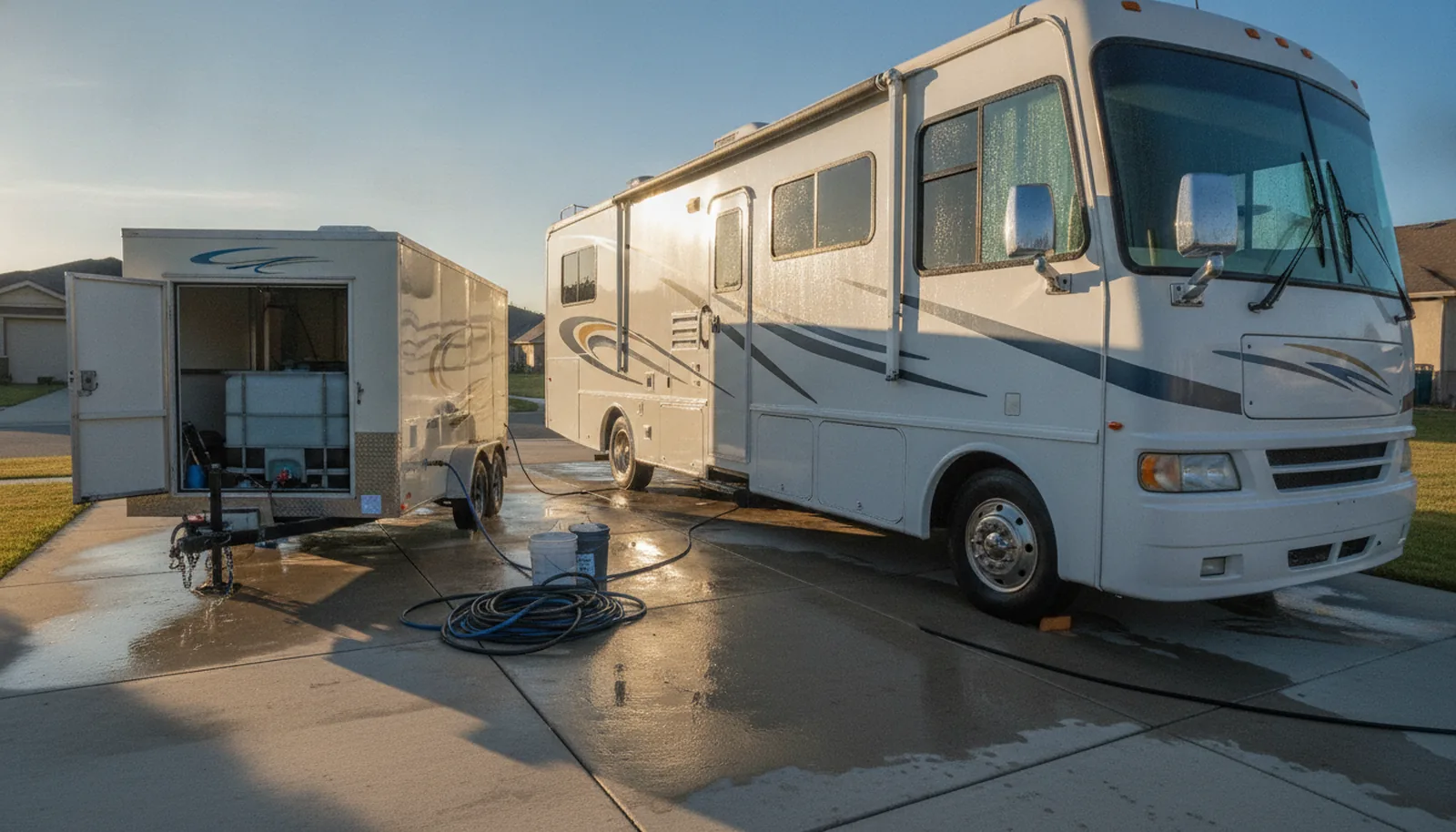
Last August I chased a wash-and-seal on a 38-foot Class A in North Naples. Sun held for maybe twenty minutes. Then a thunderstorm parked over the driveway and rinsed half the sealant straight into the storm drain. I stood under the awning with the owner, both of us staring at the front cap while the beading just gave up right in front of us. That one cost me a redo. It also taught me exactly when mobile RV detailers in Naples beat a bay. Some days you cant outrun the weather. Some days the money says stay put, move nothing, and work where the rig sleeps.
Mobile RV Detailing vs a Shop Bay: The Honest Trade-Off
A mobile detailer shows up at your driveway, storage lot or park with water, power, products and a ladder. A bay gives you a roof, lights, a drain and a second guy to hold the ladder.
When I ran a truck around Naples and Fort Myers, I learned that mobile work is about control. Here’s how the two stack up:
| Factor | Mobile RV detailer | Shop with an RV bay |
|---|---|---|
| Convenience | Comes to you. No hitching up, no height worries on a 13-foot Class A. | You drive to them. Bay height and length may rule out some rigs. |
| Weather risk | Sun, wind, pop-up storms. Heat stops oxidation work by early afternoon. | Controlled. Rain, dew and UV mostly irrelevant. |
| Water and power | Some use your spigot and outlet; others carry a tank and generator. Ask. | Bay gives both. No hoses across the caliche. |
| Runoff and reclaim rules | Your driveway or lot has no drain. Water goes to the street or soaks in. HOAs and parks may require containment. | A bay usually drains to a sewer or reclaim system, but rules still apply. Ask how they discharge. |
| Lighting for paint correction | You work in daylight or with portable LED. Sun glare hides swirls. | Bay lights show defects on every panel. You can compound at night. |
| Roof access and fall safety | On a ladder or from the ground with a pole. A 13-foot roof is a real fall risk. | Many bays have scaffolding or a catwalk. Safer for full roof work. |
| Scheduling | Often one guy, one job. Rain reschedules you. | Can run two jobs at once, but you wait for a bay slot. |
| Price structure | Per-foot quote, sometimes a trip fee. Storage lots may add a wash fee. | Bay rate or per-foot, but no trip fee. Tall rigs may cost more for bay time. |
Mobile saves you a drive and sometimes the price of storing a rig for a day. The best detailer, mobile or shop, is the one who tells you which job fits which roof.
When Mobile RV Detailing Wins
If you own a 40-foot diesel pusher and you don’t want to back it out of a storage lot, mobile is the only answer that doesn’t risk a wall. Ive washed coaches in storage rows so tight I could touch the neighbor’s slide with my elbow.
Mobile also wins on regular maintainance. A wash-and-wax every six to eight weeks is a three-hour job for a mobile guy with good water.
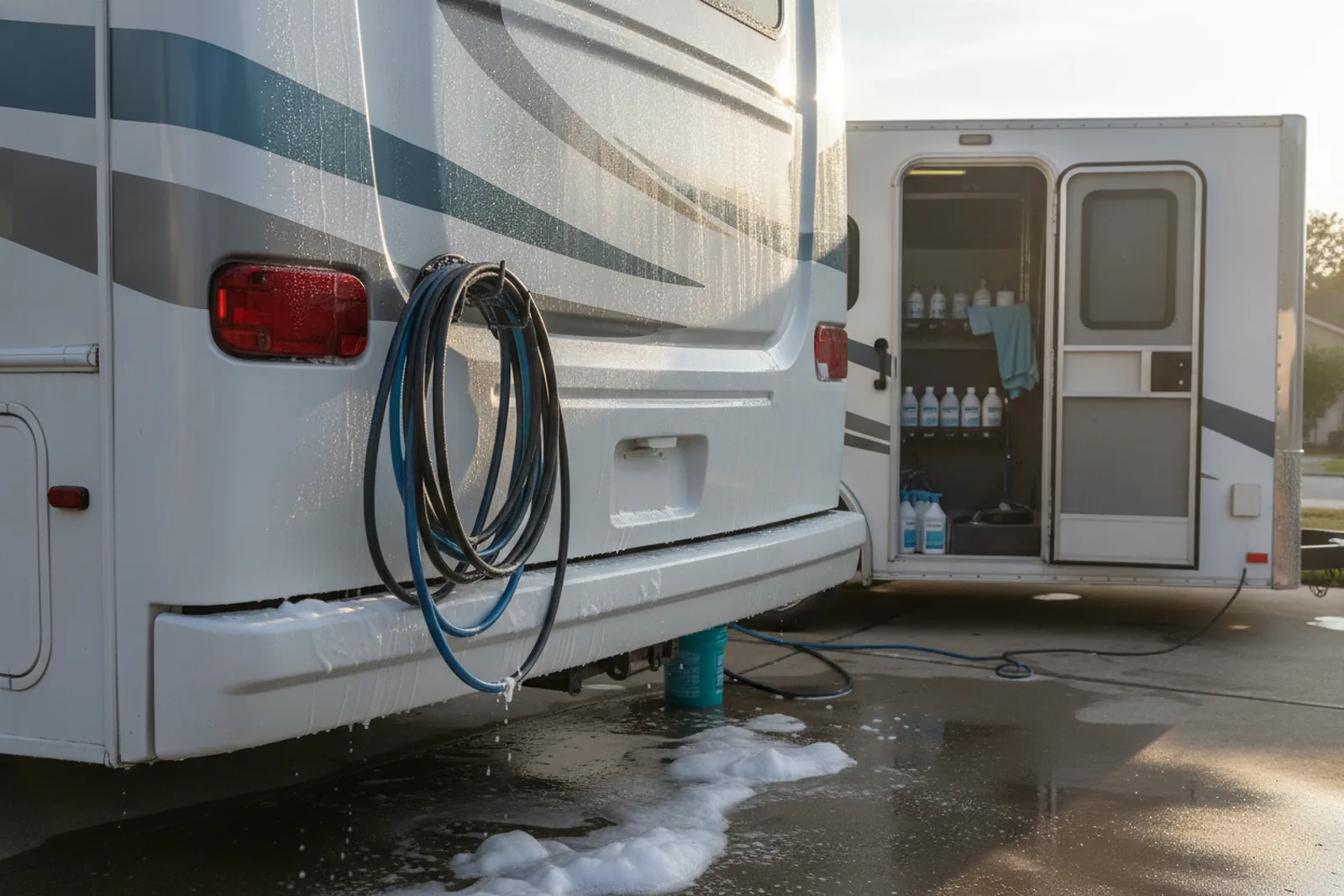
Storage-lot jobs are where mobile shines. Many lots ban washing. Some allow it with a wash permit and a detailer who carries water. Others allow only approved vendors. If your lot says yes, get that in writing and give a copy to the mobile RV detailers nationwide.
When a Shop Bay Wins
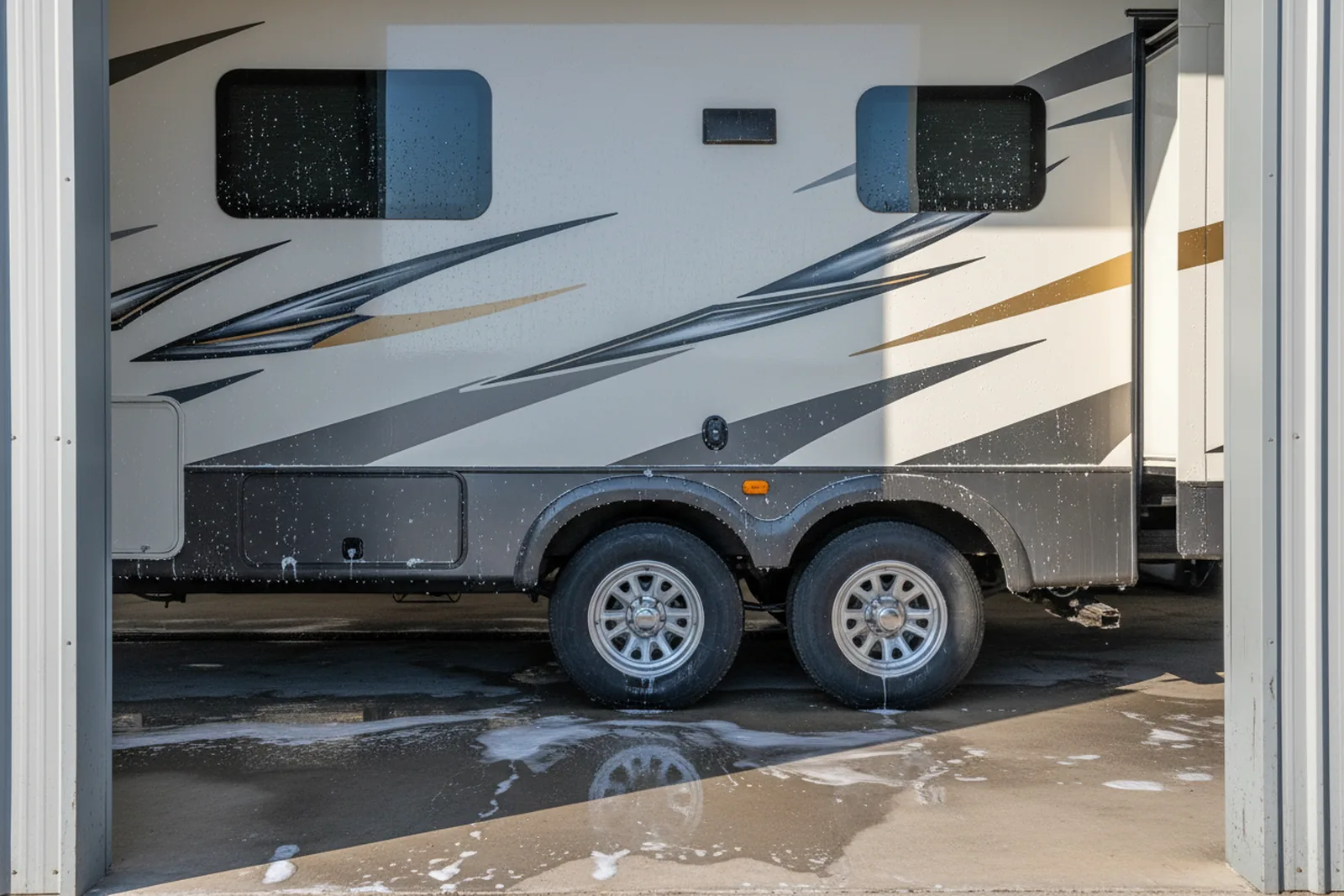
Heavy oxidation correction should go inside a bay. You can compound gelcoat in the sun, but you’re working on a clock. Once the panel hits 100 degrees, polish dries into dust and you’re burning through clear coat or gelcoat.
Ceramic coating is the other bay job. A coating has to cure without dew, rain or direct sun for hours, sometimes overnight. Florida nights bring dew by ten. If the rig sits outside, the coating can water-spot before it crosslinks.
Winter up north is the third bay win. Below 40 degrees, soap doesn’t foam, wash water freezes on the rocker panels and your tanks freeze on the drive home. A heated shop bay is the only sane option from November to March.
What to Ask a Mobile Detailer Before They Touch the Rig
I’ve been the guy on the other end of these questions.
- What insurance do you carry? General liability alone often excludes damage to the rig in your care. Garagekeepers coverage is what pays if a buffer burns through a decal. Ask for a certificate and make sure it names the storage lot or park as also insured if required. More on this in our post on RV detailing insurance.
- Whose water and power are you using? If they run off your spigot, is your water pressure enough for a pressure washer? If they carry a tank, how do they refill between a Class A and a fifth wheel? Generators are loud. Your neighbors will care.
- Does the storage lot or HOA allow washing? Most don’t, or they require a written permit. Many parks allow only approved vendors. Get it in writing. I’ve been kicked off property twice. Both times the owner swore he’d checked.
- How do you handle runoff? Federal stormwater rules push cities to require containment. Some mobile detailers use berms and vacuums. Some don’t. If water runs into a storm drain and a neighbor films it, you could share the fine.
- What products on the roof and decals? EPDM and TPO membranes have strict no-no lists. Citrus cleaners eat rubber roofs. High-pH soap fades graphics. A detailer who grabs the same purple degreaser for everything is not your guy.
Ask all five before you agree to a date. My post on how to pick the best RV detailing company has the full list I’d want asked of my own shop.
What Mobile Costs vs a Bay (and Why the Quote Isn’t the Price)
Most detailers quote per linear foot of rig length. Wash only runs about $3 to $5 per foot. Wash and wax runs $10 to $16 per foot at the common end. Oxidation removal starts around $15 per foot for light chalk and jumps to $30 per foot and up for real correction. Ceramic coating can spread from $24 per foot for a one-year product to $100 per foot and up for a two-year coating with proper decontamination.
A shop bay may cost the same per foot but adds bay time. Some charge by the hour after the first day. Mobile guys add a trip fee, a minimum, or a wash fee at the storage lot.
What realy changes the price is the roof. A 30-foot fifth wheel with a clean TPO roof washes in two hours. Oxidation is the killer. One 41-foot fifth wheel took an owner nine hours of hand work.
The Weather Problem I Can’t Fix on a Driveway
Last August was not my finest hour. A customer in Naples handed me a wash-and-seal on a 38-foot gas Class A. I had the roof done and half the passenger side sealed when the sky went from blue to black in ten minutes.
That job pushed me to write a simple rule. On a driveway in summer, I only wash and use a spray wax that doesn’t care about a little dew.
This is what I tell every customer now: the price doesn’t buy you weather. It buys you the detailer’s judgement about weather. If a guy promises a ceramic coating on an August afternoon in south Florida, outside, under a tree, he’s selling a story, not a coating.
If you’re wondering about common RV cleaning mistakes, this video from RVcleaningacademy clears up a few myths.
Runoff, HOAs and Park Rules: The Part Nobody Reads
Federal stormwater rules have pushed cities to consider mobile washing a discharge.
At an RV park, ask the office before you schedule. If the detailer says he washes there all the time, call the office anyway.
The detailer’s water setup matters. A guy running off your spigot with no containment is relying on your driveway’s slope into the grass. That’s fine until a neighbor complains to the city. A guy with a water tank and a reclaim mat is more expensive but safer. I now carry a portable berm and a sump pump. It cost under $400 and saved me a $1,200 county fine once. Get permission in writing and tell the detailer to show you his discharge plan.
The Towel Test and a Weekend Call
I’m willing to be wrong about this: most RV owners overpay for ceramic coatings and underpay for regular washes.
This weekend, run a dry white towel across your front cap. Then call two places, one mobile and one bay, and ask for a written per-foot quote on the same job: wash, roof clean and sealant. Ask the same five questions. The one who answers them all without laughing is your detailer.
Keep reading
FAQ
How much does mobile RV detailing cost?
Most charge by the foot of rig lenght. A wash runs about $3 to $5 per foot. Wash and wax runs $10 to $16 per foot. Oxidation removal starts around $15 per foot and rises with severity. Add trip fees or minimums if the location is far or remote.
Is mobile RV detailing legal everywhere?
No. Stormwater rules and local ordinances vary. Many cities treat commercial washing on a driveway or lot as a discharge violation unless water is contained. Some HOAs and RV parks ban washing or require an approved vendor. Check your city, HOA or park office and get permission in writing before scheduling.
Do mobile RV detailers use my water?
Some use your spigot and a standard outlet. Others carry a water tank and generator for storage lots and parks without hookups. Ask which setup they use. If they use your water, make sure your pressure and hose reach the rig without damage.
Can a ceramic coating cure outside?
Coatings need dry, mostly controlled conditions for hours, sometimes overnight. Dew, rain or direct sun during the first hours can cause water spots or uneven curing. For a coating job, many detailers prefer a bay or a very dry day with no overnight dew.
Does my RV need a bay for oxidation removal?
Heavy correction is easier in a bay becuase the panels stay cool and lights show defects. But a skilled mobile detailer can compound outside if he starts early and works small sections. Ask if he has a plan for heat and direct sun.
How do I prove oxidation before paying for correction?
Run a clean white towel or your hand across the sidewall. White chalk on the towel means the gelcoat is oxidized. A detailer should do the same test before quoting compound work. If they don't, find another detailer.
What insurance should a mobile RV detailer have?
General liability alone offen excludes damage to the rig in the detailer's care. Look for garagekeepers coverage. Ask for a certificate naming the storage lot or park also insured if required. Verify the coverage is active for the date of service.
Find RV detailers near you
Compare RV detailers and mobile washes in your city, then ask a few for a price.
Browse by state