Best RV Detailing: 10 Questions to Ask Before You Hire
By Hector Salas · October 21, 2026
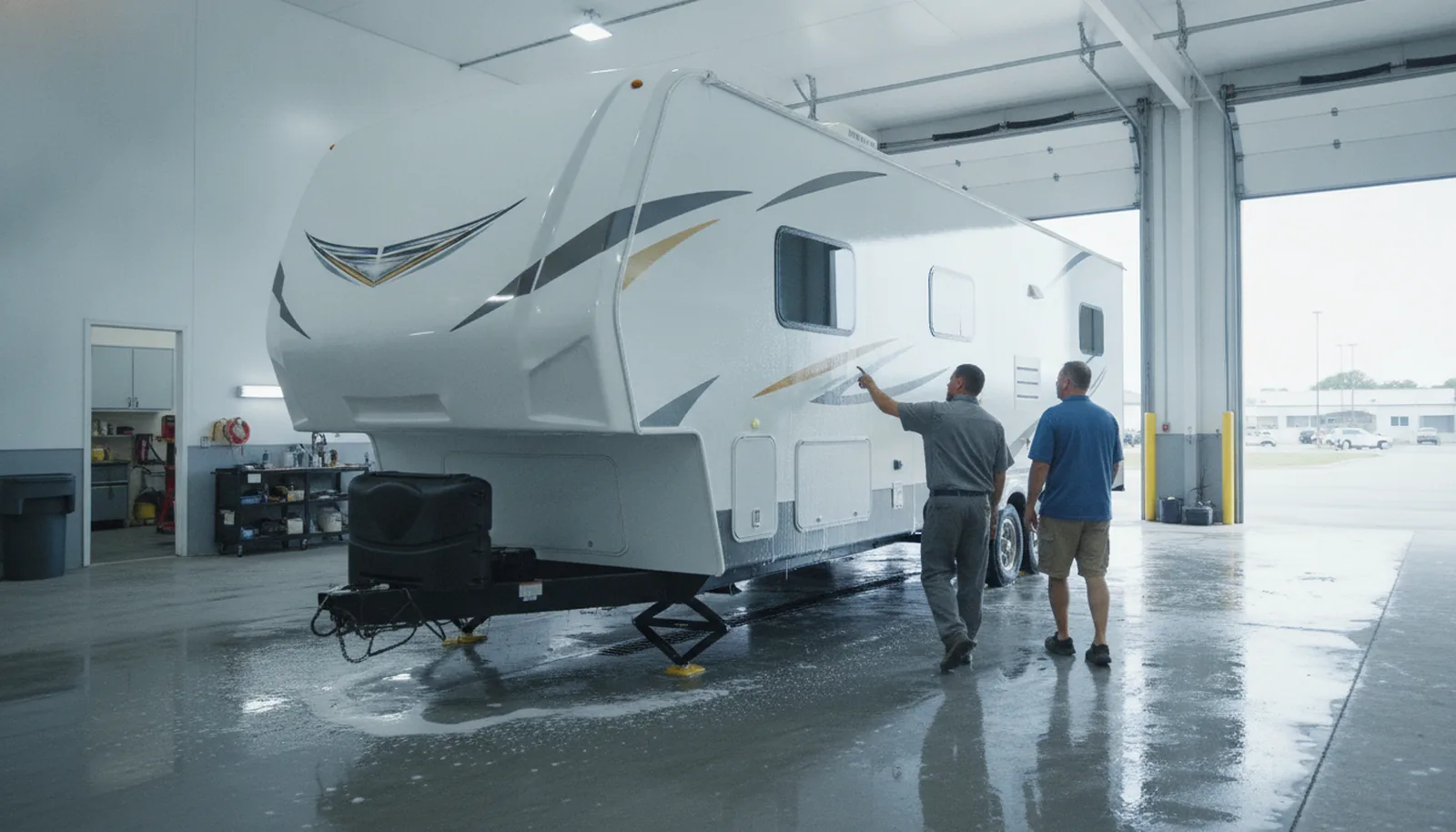
Last June I parked my 30-foot travel trailer in the driveway after a week at Milford Lake, Kansas. The passenger side looked like I’d driven through a dust storm, which I basically had. A neighbor asked who I used for the best RV detailing. I told him I do it myself, and he laughed and said, ‘No, who do you pay when you’re tired of doing it?’ That’s when you start looking for RV detailers in Dallas.
So here are the 10 questions I’d want asked of my own shop. If you’re in Texas, start with the RV detailers in Dallas and use these questions to cut the list down.
1. Do you price per foot, and what exactly is included in the best RV detailing?
Most RV detailers quote by the linear foot, but what’s included matters more than the per-foot number.
A wash without a spot-free rinse on Kansas hard water leaves mineral spots that etch into gelcoat over time.
I charge per foot because length and height drive my time, and a 45-foot Class A with full-body paint takes me longer per foot than a 30-foot trailer with Filon siding. A 45-foot Class A with full-body paint takes me longer per foot than a 30-foot trailer with Filon siding. If a detailer won’t commit to what’s included, walk away.
2. Are you insured, and does it cover my rig while you’re working on it?
This is the one that separates pros from hobbyists.
Ask for a certificate of insurance with you named as also insured. If they hesitate, that’s your answer.
Bad answer: ‘I’m careful, nothing’s ever happened.’ That’s not insurance.
For more on what coverage a mobile detailer should carry before touching a $300,000 coach, read my post on RV detailing insurance.
3. How do you clean the roof, and what cleaner do you use on my membrane?
The roof membrane is the most expensive thing to replace on most RVs, and the easiest to damage with the wrong chemical.
Ask them to name your roof material.
Bad answer: ‘I hit it with a citrus cleaner and a power washer.’ That can damage the membrane and void your roof warranty.
On my own trailer, I use a rubber-roof cleaner and a long-handled brush twice a year. It keeps the black streaks down and catches sealant cracks early.
4. Do you walk on the roof, and how do you stay safe up there?
I walk roofs, but only when the manufacturor says it’s walkable.
Bad answer: ‘I just walk it, it’s fine.’ That’s how you crack a roof deck and end up with a leak.
Walking the roof isnt the only way to clean it.
When a rig comes into my bay, I look at the roof before I do anything else, and if I see cracked lap sealant, I tell the owner before I clean. If I see cracked lap sealant, I tell the owner before I clean. That’s part of the inspection a $300 wash should include.
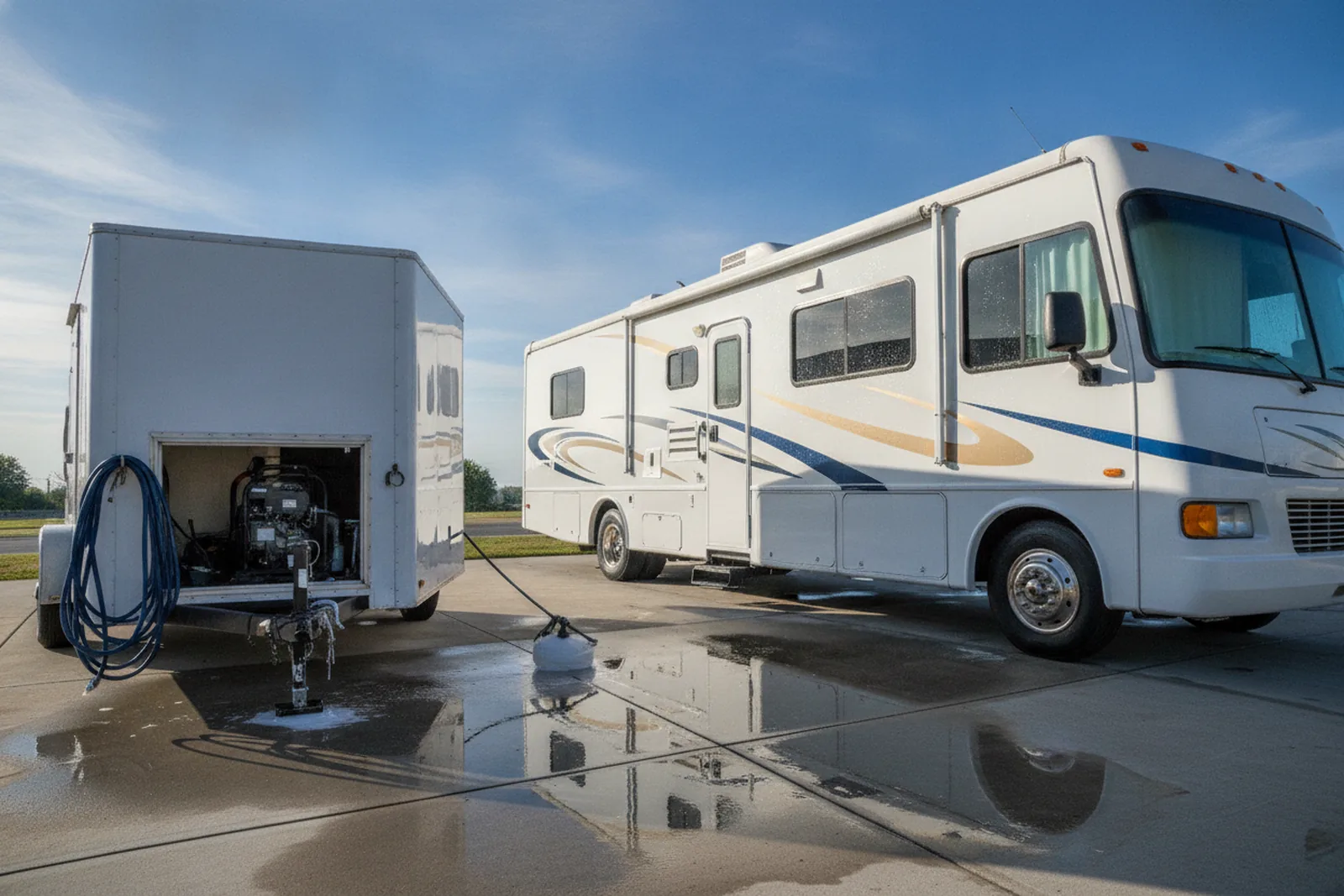
5. What protection do you use by category, and how long should it last?
This is where the oversell happens.
Bad answer: ‘This spray wax lasts nine months.’ Spray wax typically lasts only a few weeks to a couple of months, and it goes on wet. I had a custumer pay $800 for a ‘ceramic coating’ that was a spray sealant from a big-box store. It lasted only a few weeks.
Protection is only as good as the surface under it. Correction comes first, and that’s why a coating job on an older rig costs more than the coating.
I found this walkthrough helpful for seeing how a pro approaches large RV details.
6. How do you handle decals and painted caps?
Decals are the first thing an amateur ruins.
Bad answer: ‘I hit everything with the pressure washer, it’s faster.’ That’s how you get peeled graphics and a $400 replacement bill.
Painted caps are a different problem.
My trailer has standard Filon siding and a molded fiberglass cap. The cap fades faster because it faces the sun, so I hit it with a cleaner wax twice a year. Decals get washed by hand and left alone. The fronts of my decals show some sun fade after five years,but the edges are all intact, and that’s what matters.
7. What polisher do you use, and who runs it?
There are two kinds of polishers: dual-action and rotary.
Ask who specifically will be doing the machine work. The owner paid me $1,800 to re-clear the cap, and the orginal detailer was nowhere to be found.
For most rigs, a dual-action polisher with a foam pad and a medium compound is all you need to remove light oxidation. A rotary only comes out for heavy chalk. If the detailer can’t tell you the difference, they’re not a detailer.
8. Where does your water come from, and do you have permission to wash here?
If you’re at a campground or an HOA lot, the detailer needs permission from the office or the association.
Bad answer: ‘I just showed up and washed it.’ If the park manager sees runoff going into a storm drain, both of you could get fined.
Water quality matters too.
Ask where they got their last three jobs. I turn down jobs at campgrounds that won’t let me wash, and I tell the owner why.
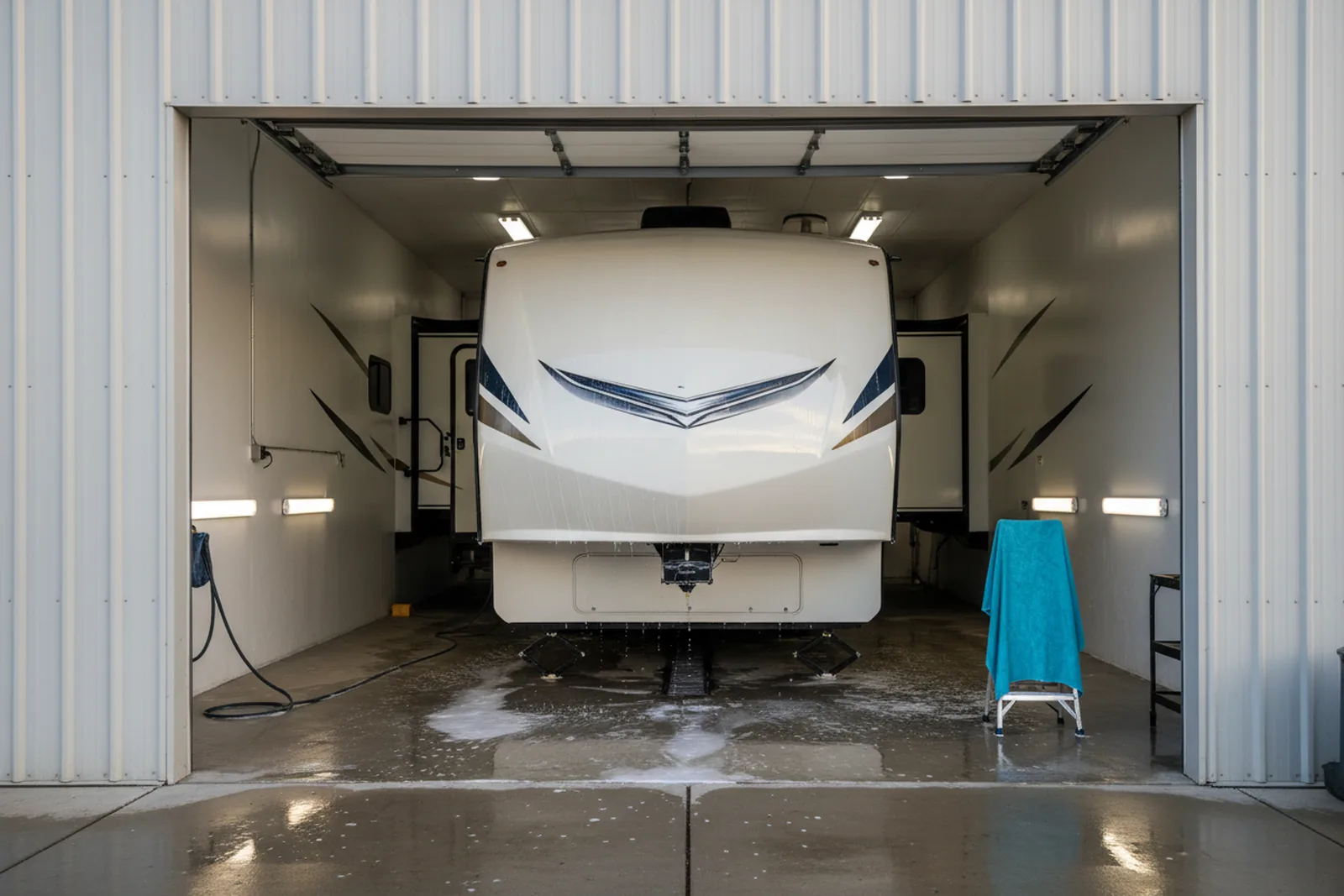
9. Can I see photos of similar RVs you’ve detailed, before and after?
Bad answer: ‘I don’t take photos, but my work speaks for itself.’ That means they don’t have any work to show.
Look for RVs like yours: a travel trailer with Filon siding, a motorhome with full-body paint, a toy hauler with heavy oxidation.
I keep a few hundred photos on my phone, sorted by rig type. Read reviews specifically for RV jobs, not car details. Search the detailer’s name plus ‘RV’ and see what comes up.
10. What happens if you damage something?
Bad answer: ‘I’ve never damaged anything.’ Or worse, ‘That scratch was already there.’
I had a mobile detailer work on a friend’s Class A and crack a tail light lens. The guy swore it had a hairline crack before he started. Funny how that crack was invisible in the walkaround video from two hours earlier.
Ask them to put it in writing: an estimate and a damage policy.
For more on what I wish I knew before running an RV bay, read my post on starting an RV detailing business. It covers the business side of damage and insurance from my side of the buffer.
The test I’d run before signing anything
Here’s a small test you can do this weekend. Pick two of the RV detailers in Texas from your area, or whatever list you have, and ask them both for a written per-foot quote on the same job: wash, wax, roof inspection, spot-free rinse. Then ask if you can watch the first 15 minutes.
If one says no to the watching part, I’d have questions. My bay door is open. Wander in. I’ll hand you a pair of safety glasses and tell you what I’m looking at.
I’m willing to be wrong about this, but I think the best RV detailing company is the one that treats your rig like it’s their own and still makes money. Because if they’re not making money, they’re cutting corners somewhere. And the corner they cut is usually your roof.
Before you grab the buffer
FAQ
How much should I pay for a basic RV wash and wax?
Most detailers charge roughly $10 to $16 per linear foot for a wash and wax, but roof cleaning and spot-free rinse may be extra. A 30-foot travel trailer would be roughly $300 to $480, but prices vary by condition, region, and what's included. Get a written quote with all steps listed, and be wary of quotes well below the typical range for a wash and wax unless they itemize what's skipped.
Can a mobile detailer wash my RV at a campground?
Only if the campground allows it. Many parks ban RV washing, require a fee, or insist on a shutoff nozzle and water containment. The detailer shoudl confirm with the office beforehand, not assume. Some HOAs and city ordinances also restrict runoff. A good mobile detailer brings berms, drain covers, or a water reclaim system to stay legal and avoid fines.
Is it safe to pressure wash an RV roof?
Generally no. Roof membrane makers for EPDM and TPO specify scrubbing with a brush and rinsing with a hose, not a pressure washer. High pressure can force water under lap sealant, peel decals, and damage membranes. If a detailer pressure washes your roof, they're going against manufacturer care sheets. Keep pressure washers off the roof and away from decal edges and window seals.
What's the difference between a $300 RV wash and a $600 one?
The $300 wash might skip the roof, use a cheap soap that strips wax, and dry with dirty towels. The $600 one includes roof cleaning, a spot-free rinse with deionized water, hand drying, and an inspection of sealant and decals. The per-foot price should reflect the steps included. Ask for a written checklist, not just a price.
How often should I wax my RV?
RV makers' wax intervals vary; some suggest every 3 to 6 months if stored outside, others 2 to 4 times a year. Check your owner's manual. Carnauba wax typically lasts 1 to 4 months; synthetic sealants typically last 3 to 6 months, but RV exposure shortens these. A good detailer will recommend a schedule based on your rig's material, your region's sun and salt, and how you store it. Desert sun shortens wax life fast.
Does ceramic coating replace waxing?
Ceramic coating is a longer-lasting, harder layer than wax, but it doesn't end maintenance. You still wash with pH-neutral soap and may need a spray topper evry few months. Coatings can last longer than wax, but durability claims vary widely and often fall short on RVs stored outdoors. And you can't coat over oxidized gelcoat; correction must come first, which adds cost.
What should I do if a detailer damages my RV?
Document the damage with photos taken the same day, and get the detailer to acknowledge it in writing. If they have garagekeepers insurance, ask for a claim number. If they dont, their general liability may not cover your rig, so check your own policy and consider legal advice. That's why verifying insurance before the job is important; many detailers skip garagekeepers coverage.
Find RV detailers near you
Compare RV detailers and mobile washes in your city, then ask a few for a price.
Browse by state