Detailing an RV Yourself: Weekend Order of Operations
By Bev Lindqvist · October 21, 2026
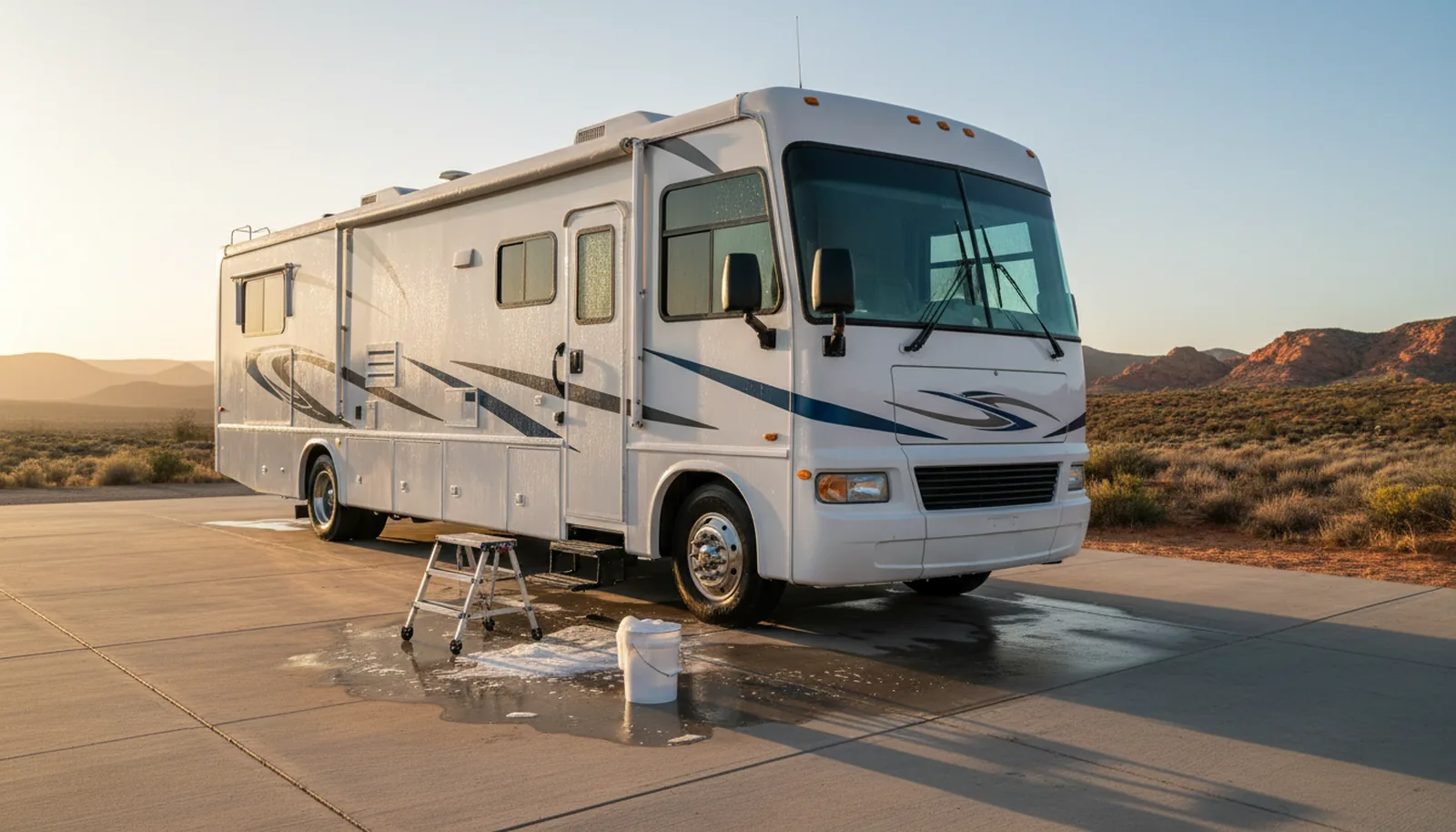
Two Octobers ago I was in a friend’s driveway in St. George, Utah, with my 2015 40-foot Class A diesel and a ladder, not far from where I’d later find RV detailers in St. George. I’d spent the morning on the roof and by noon my knees were done. Not sore. Done. I checked my cleaning log: that roof had taken two hours and one bottle of rubber-roof cleaner, and I still had three hours of washing and waxing below me. That was the day I started paying someone else for the roof and figured out a whole-rig routine that doesn’t wreck my back. The roof is now a hired job, twice a year. The rest I still do myself, most weekends, if the weather lets me.
Before You Start: Rules, Weather and a Walkaround
Check the campground or HOA rules first. Some parks ban RV washing outright, and some cities require wash water to be contained and sent to a sewer, not a storm drain. Ask the office.
Then walk the whole rig before you touch a hose. Look for cracked sealant, loose trim, chips in the gelcoat. I keep a note in my phone with a diagram of my coach and the spots that need attention before I make anything wet.
Desert heat cycles are brutal on wax, so I work panel by panel and never wash or wax in direct sun. That walkaround often reveals what the roof has been hiding.
Roof First, and Mine Is a Hired Job Now
I used to climb up there with a brush and a hose. Now I pay a mobile detailer to do just the roof about twice a year, and I ask for somthing extra: a written note on any cracked lap sealant they see up there.
If you do your own roof, follow the membrane maker’s care sheet. My rubber roof gets a cleaner made for EPDM, no petroleum solvents, no harsh abrasives, no citrus.
Safety: never step on skylights or vents. For a step-by-step wash, see my post on how to wash an RV, which covers roof rinse and seal protection. Once the roof is clean, everything below it stays cleaner longer.
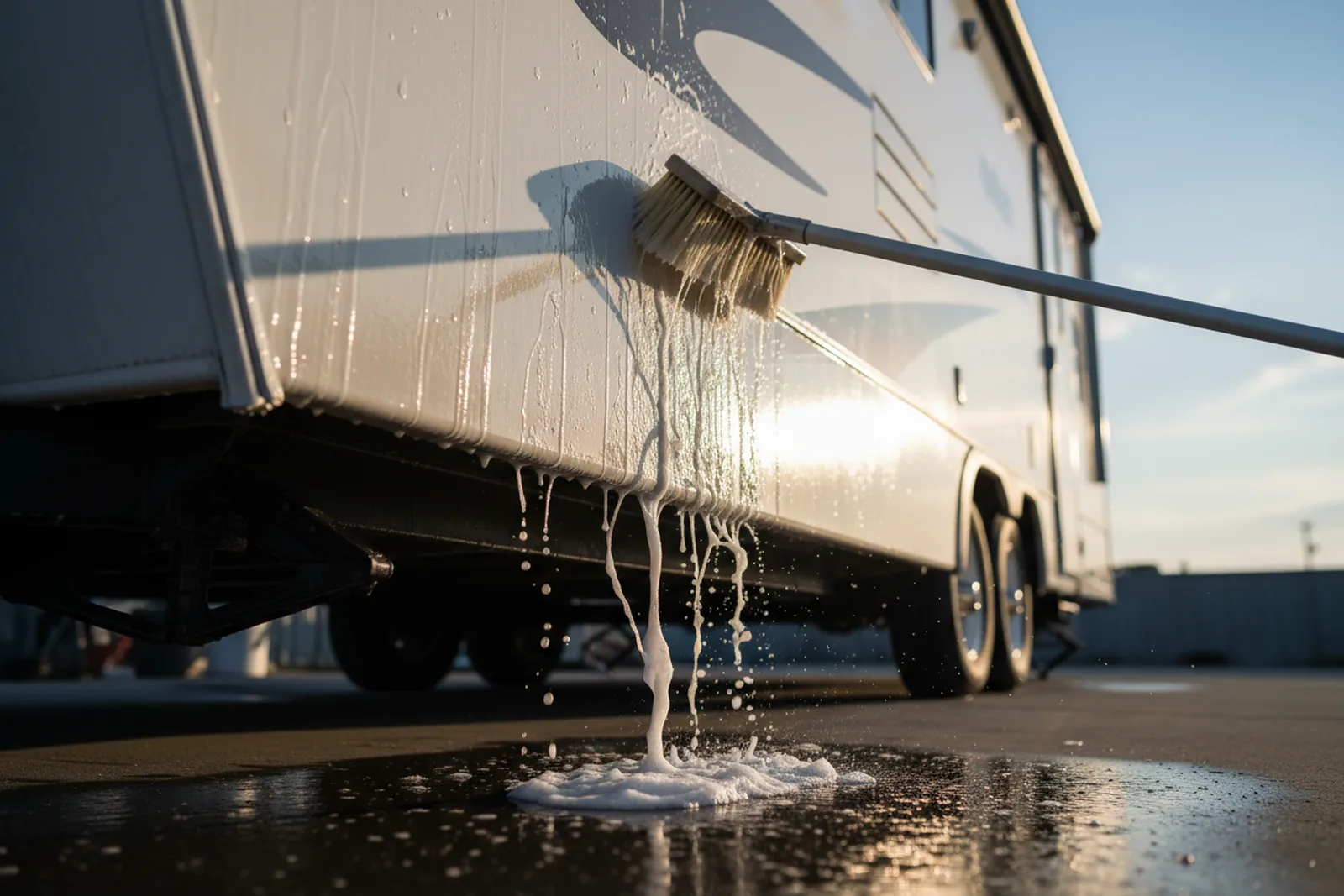
Top-Down Wash With a Soft Long-Handled Brush
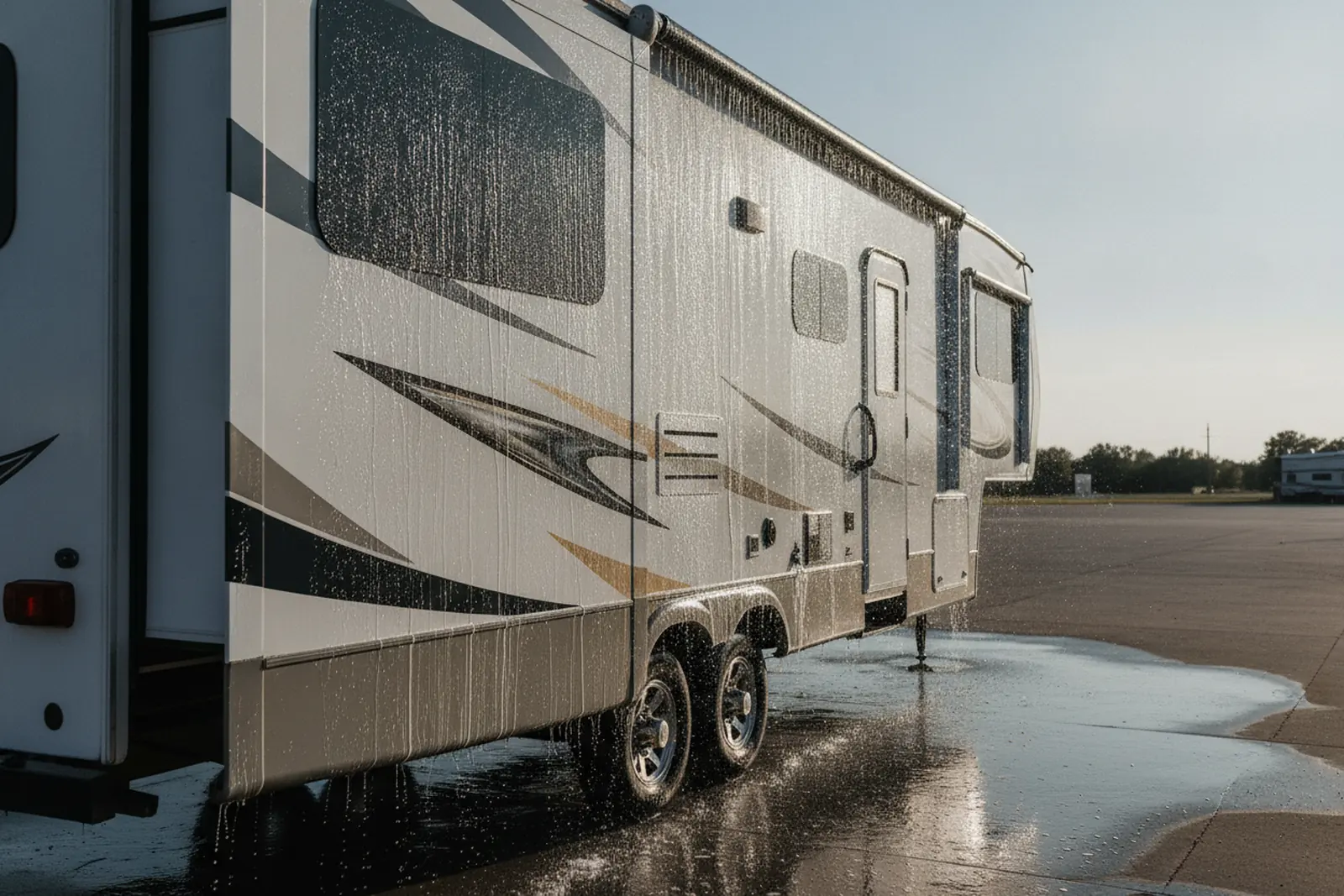
Rinse from the top down with a fan spray, never a straight stream near seals or decals.
A good wash on a 30-foot fifth wheel took the owner about three hours. Dry with a squeegee and a microfiber towel. Hard water spots are just dissolved minerals left behind when the water dries. If your water is hard, a deionized rinse helps, or you dry fast.
For paint, keep the surface under 90°F and out of direct sun. Cotton or lamb’s-wool mitts only, no brushes on clear coat. I don’t pressure-wash my coach. If you use one, never use the red zero-degree tip, and keep the wand at least 12 inches from decals and seals. A clean rinse sets you up for the bugs and tar, which water alone won’t touch.
Decontaminate: Bugs, Tar, Tree Sap and Rail Dust
After washing, I walk the front cap and lower panels with a bug remover and a soft towel.
If the surface feels rough after washing, I’ll clay a panel or two with a clay mitt. Only in the shade, and I keep the surface wet with clay lube or soapy water.
For water spots, a little vinegar in the wash water softens minerals, and I dry immediately. If I see black streaks from the roof or gutters, I use a cleaner labeled safe for RV fiberglass and then re-wax that section. Once the surface is clean and smooth, the towel test tells me what to do next.
Detailing an RV: The Towel Test Decides Wax or Polish
Rub a clean white towel across a faded area.
The order is: wash, decontaminate, compound (the heaviest cut you need), polish, then protect.
If the towel comes away clean, I go straight to wax or a synthetic sealant. A carnauba wax might last one to four months on an RV that lives outside. A ceramic coating is a bigger job with a bigger price, but it can last a year or more if you wash carefully. Don’t coat over chalk. Correct first.
I use the list in my RV detailing supplies post as a kit checklist: two buckets, pH-neutral soap, bug remover, clay mitt, compound, polish, wax or sealant,microfiber, and a dual-action polisher.
I found a video that shows the whole process on a motorhome, step by step. It helped me see where I was wasting time.
Glass, Trim, Tires and a Printable Checklist
Glass gets a dedicated glass cleaner and a waffle-weave microfiber.
The last thing I do befor the interior is touch up the black streaks under the gutters and check the gutters themselves. That cuts black streaks a lot, and that’s the whole reason I do it last.
Below is the checklist I print and keep in my cleaning log. Times are for my 40-foot Class A; a 30-footer will take less, a 45-footer more.
- Gather supplies and check rules; walkaround (30 min)
- Roof cleaning or hire it out (2 to 3 hours, or a check)
- Rinse and wash top-down with two buckets (2 to 4 hours)
- Decontaminate bugs, tar, sap; clay if rough (1 to 2 hours)
- Towel test for chalk; choose wax, polish or compound (10 min)
- Apply protection panel by panel out of direct sun (2 to 4 hours)
- Glass, trim, tire dressing; check gutters and drip spouts (30 min)
- Interior vacuum and wipe-down last (1 to 2 hours)
Interior Last: Vacuum, Wipe, and Don’t Mix Bleach
I do the interior after the exterior so I’m not tracking dust back out. Vacuum everything, then wipe hard surfaces with a mild all-purpose cleaner. For fabric, I spot-clean with an enzyme cleaner if there’s an odor. Don’t mix bleach with ammonia or any other cleaner. The fumes can hurt you.
A deep interior clean is a separate day for me, usually. I’ve had good luck with a small extractor on the dinette cushions. For the ceiling and vents, a swiffer and a microfiber on a pole keeps me off a ladder.
Some campgrounds charge a wash fee or require a shutoff nozzle. If I’m on the road and can’t wash at the site, I’ll find a mobile detailer thru a local search, like RV detailers across Utah, and ask for a wash-only or a roof-only job.
The Step I Wish I’d Hired Out Sooner
The roof. I spent years climbing a ladder with a brush and what finally broke me wasn’t the work. It was the risk. A detailer in St. George now does my roof twice a year for less than a doctor’s visit after a fall. He also tells me when a lap sealant is cracking, which I’d never see from the ground.
Here’s a small test: after your next wash, rub a clean white towel accross the lower half of your front cap. If it comes away chalky, you have oxidation, and no wax will fix it. Either break out the compound and a foam pad, or call a mobile detailer and ask for a per-foot quote on oxidation removal. That one question saved me six hours of arm work on my last job.
If you’ve been putting off a full detail, pull up mobile RV detailers or shops with an RV bay near you and ask two of them for a written per-foot quote on the same job: wash, decontaminate, protect, and roof if you want it. That’s the fastest way to know if your weekend is worth more then the check.
Before you grab the buffer
FAQ
How much does it cost to detail an RV?
Most detailers quote per linear foot. Wash and wax typically runs $10 to $16 per foot, so a 40-foot Class A is about $400 to $640. Oxidation removal adds $15 to $30 or more per foot. Get a written quote with what's included, becuase length, oxidation, and roof condition change the price.
How long does it take to detail an RV yourself?
A thorough wash takes about 3 hours on a 30-foot fifth wheel. Hand waxing adds over 10 hours. My 40-footer takes a full weekend if I do the roof, wash, decontaminate, and wax. Hiring the roof or the whole job is the best time-saver.
What's the difference between wax, sealant, and ceramic coating?
Carnauba wax lasts 1 to 4 months on an RV that lives outside. Synthetic sealant lasts 3 to 6 months. Ceramic coatings can last a year or more but cost more and require correction first. All need pH-neutral washing to last.
Can I pressure-wash my RV?
You can if you're careful, but I don't. High pressure can get past seals, peel decals, and cut sealant. Never use the red zero-degree tip. If you must, keep the wand at least 12 inches from decals and seals, and use a low setting near windows and vents.
How do I know if my RV gelcoat is oxidized?
Rub a clean white towel over the sidewall. If the towel shows chalk, that's oxidation. Wash first, then compound and polish before waxing. Wax alone won't fix it. Work in small sections with a dual-action polisher.
What should I use to clean my rubber RV roof?
For EPDM rubber roofs, use a cleaner made for rubber, not petroleum solvents or citrus. For TPO, dish soap and a medium-bristle brush works. Never wax a rubber roof, and don't use harsh abrasives. Check your membrane maker's care sheet.
Can I wash my RV at a campground?
Some campgrounds ban washing, some allow it with a shutoff nozzle, some charge a fee. Always ask the office. Cities may require wash water to be contained and sent to a sewer instead of a storm drain. Check your city's rules before you start.
Find RV detailers near you
Compare RV detailers and mobile washes in your city, then ask a few for a price.
Browse by state