How to wash an RV without stripping the wax or flooding the seals
By Bev Lindqvist · October 21, 2026
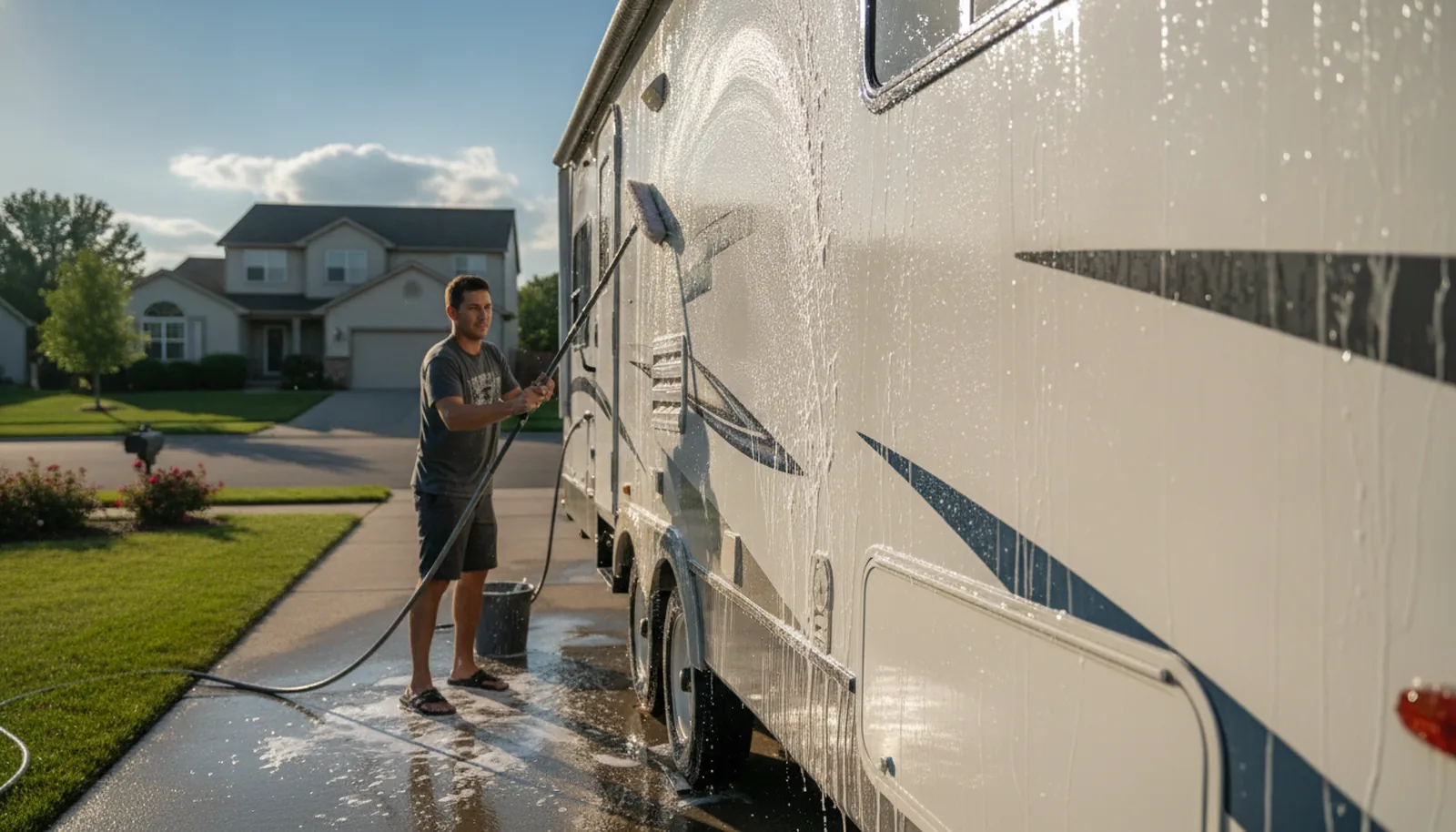
Last June I was parked in southern Nevada, the kind of place where the office lets you wash your rig but only before 9 a.m., and only with a shutoff nozzle. My 40-foot Class A had a film of desert dust and a roof I hadn’t touched since Quartzsite. (I still check mobile RV detailers in Mesa every few months.) By 8:45 every hose I owned was out, and by 9:02 the manager was walking toward me with that look. I got the rinse done, but the water dried into hard-water spots that ate three weekends of my life. The easy advice falls apart once you add a hose, a ladder, and a person tapping their watch. If I’d known then to check the rules and book a mobile RV detailer in Mesa for the times I couldn’t wash where I slept, I’d have saved a gallon of elbow grease. Learning how to wash an RV properly means knowing when you can’t.
This is my routine, step by step, for a wash that gets the rig clean without stripping the wax or shooting water into a seal. Same order whether I’m at a campground, a storage lot or my sister’s driveway, and the same one I hand to anyone who asks.
Check the rules and the runoff before you pick a day
I’ve washed in parks where it’s fine, parks where it’s banned and one HOA neighborhood where the board president watched me through binoculars the whole time. Before you drag out a hose, ask the office or check your lease. Some campgrounds allow it only before a certain hour, some charge a wash fee, some require a shutoff nozzle, and many want the runoff to stay out of the storm drain.
Call two or three mobile RV detailers near you and ask if they carry a water tank or need your spigot, and whether they reclaim their wash water.
Pick a shaded day, or at least start before the sun hits the sidewall; wash soap dries fast on warm gelcoat and leaves a haze.
Rinse the roof first, and don’t stand where you can’t
Start at the top.
I do my roof by hand with a long-handled soft brush and two buckets: one soap, one rinse. If you can’t walk the roof without sliding, don’t.
Rinse the roof angled down toward the gutters, not soaking the sidewalls. Pay extra attention to the gutters and drip spouts. A gutter full of pine needles sends black streaks down the paint the next time it rains; for now, a soft brush and a hose is enough.
Safety: if you’re in a storage lot, look up. Power lines hang low over some rigs, and a wet aluminum ladder is a conductor.
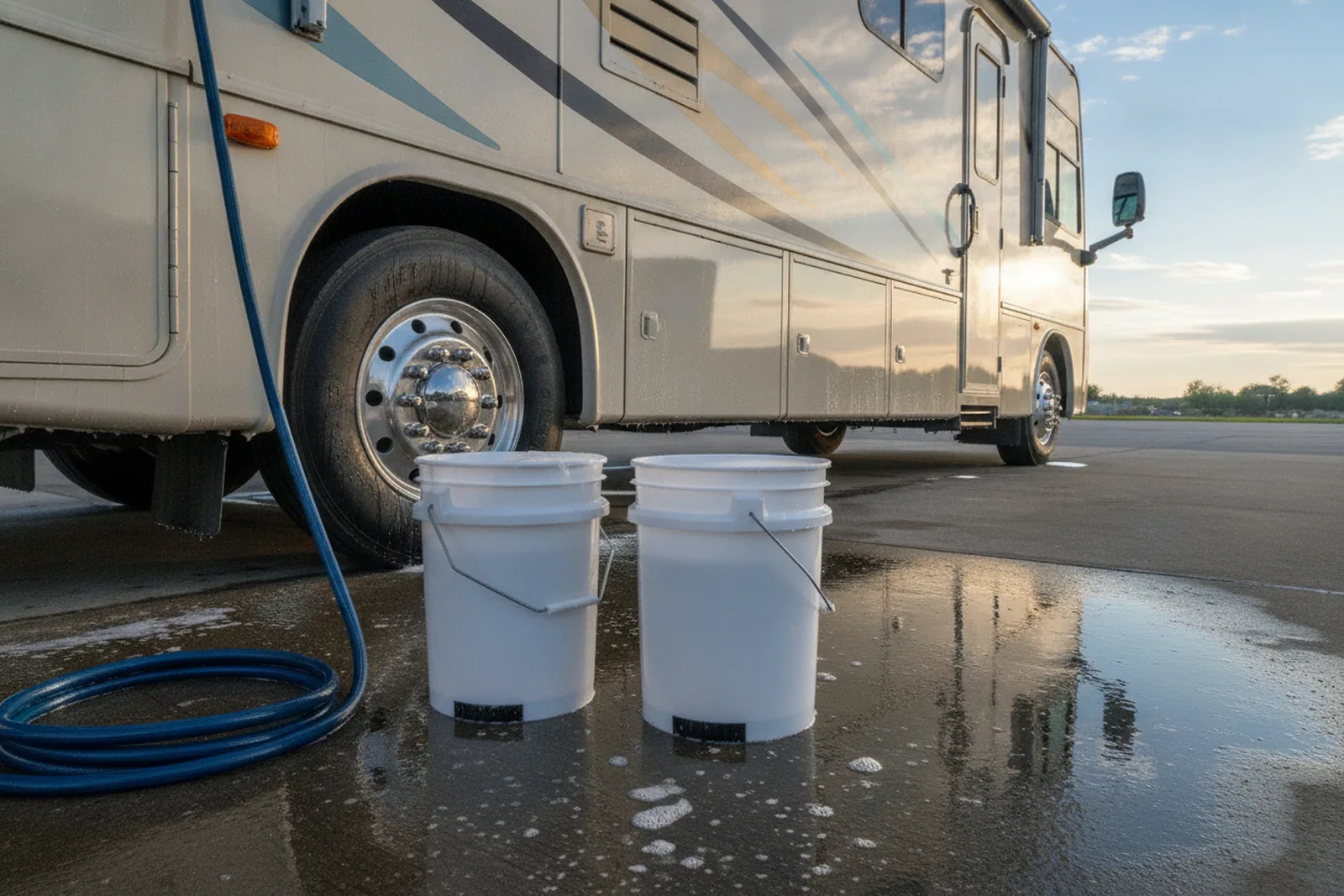
Use the two-bucket method with pH-neutral soap
I used to wash with whatever dish soap was in the galley, until I read the sidewall panel maker’s care sheet: harsh detergents strip wax and can dull gelcoat.
The two-bucket method means one bucket of soapy water, one bucket of clean rinse water.
Use a soft long-handled brush. A dirty or stiff brush scratches, and the maker’s sheet says to avoid anything gritty or abrasive. For the painted front cap, I switch to a microfiber mitt, becuase the full-body paint care sheet for my coach says no brushes on painted surfaces, ever. If your rig has full-body paint, read that sheet too: no dish soap, no straight stream close to the paint, and dry with a clean microfiber towel.
Soap isn’t the only thing that strips wax. I’ve written up the 11 RV washing mistakes I’ve seen at campgrounds, from pressure washers aimed at decals to washing in direct sun.
Scrub top-down, and treat the roof seams gently
Start at the top of the sidewall and work down.
Check the sealant as you go. Don’t caulk over wet sealant and don’t use anything with petroleum solvents on a rubber roof.
Black streaks under the gutters? Don’t scrub them while the wall is dry. The black streak removal guide goes into the cleaners that actually work and the one that made mine worse, but for a regular wash, a mild RV soap and a soft brush gets most of it off.
The decals are the weak point. Hold the brush parallel to them, never aimed at an edge. A graphics maker’s bulletin says hold the nozzle at least 12 inches away, perpendicular to the graphic, and do not exceed 1,200 psi, or the vinyl warranty may not cover damage.
Rinse with the nozzle at a distance and an angle away from seals
After you scrub a section, rinse it with a fan nozzle from at least two feet back, angled down and away from any seam.
For the roof, a soft rinse is enogh.
Water spots are the next fight, especially in the desert. Hard water leaves calcium and lime spots when it dries. If you have hard water, either dry the coach with a clean microfiber towel right after the final rinse or use a spot-free rinse filter.
A pressure washer is fine for the wheels and wheel wells, if you’re careful. I use mine at about 1,200 psi on the aluminum wheels only, and I keep the wand moving. Never aim it at the wheel bearing, the brake lines or any decal.
Dry or spot-free rinse, then the printable checklist
After the final rinse, you have two choices: dry the coach by hand or do a spot-free rinse.
If I’m short on time, I’ll use a spot-free rinse filter.
For a 25-foot travel trailer, the whole wash takes me about 2 hours, including setup and teardown.
Printable checklist
- Park in shade if possible; check the rules and runoff.
- Set up hose, two buckets with grit guards, pH-neutral soap, soft brush, microfiber towels.
- Rinse the roof with a fan nozzle, angled to the gutters.
- Clean the roof with the membrane-safe cleaner and a soft brush, two-foot sections at a time.
- Rinse the roof and gutters, and check the lap sealant.
- Fill both buckets; soak the brush.
- Scrub one section of the sidewall from top-down, then rinse with a fan nozzle from two feet back, angled away from seals.
- Repeat around the whole rig, including the front and rear caps.
- Clean the wheels and wheel wells last, with a seperate brush.
- Dry with microfiber or use a spot-free rinse filter.
- Put the the hose away, and write the next wash date on the calendar.
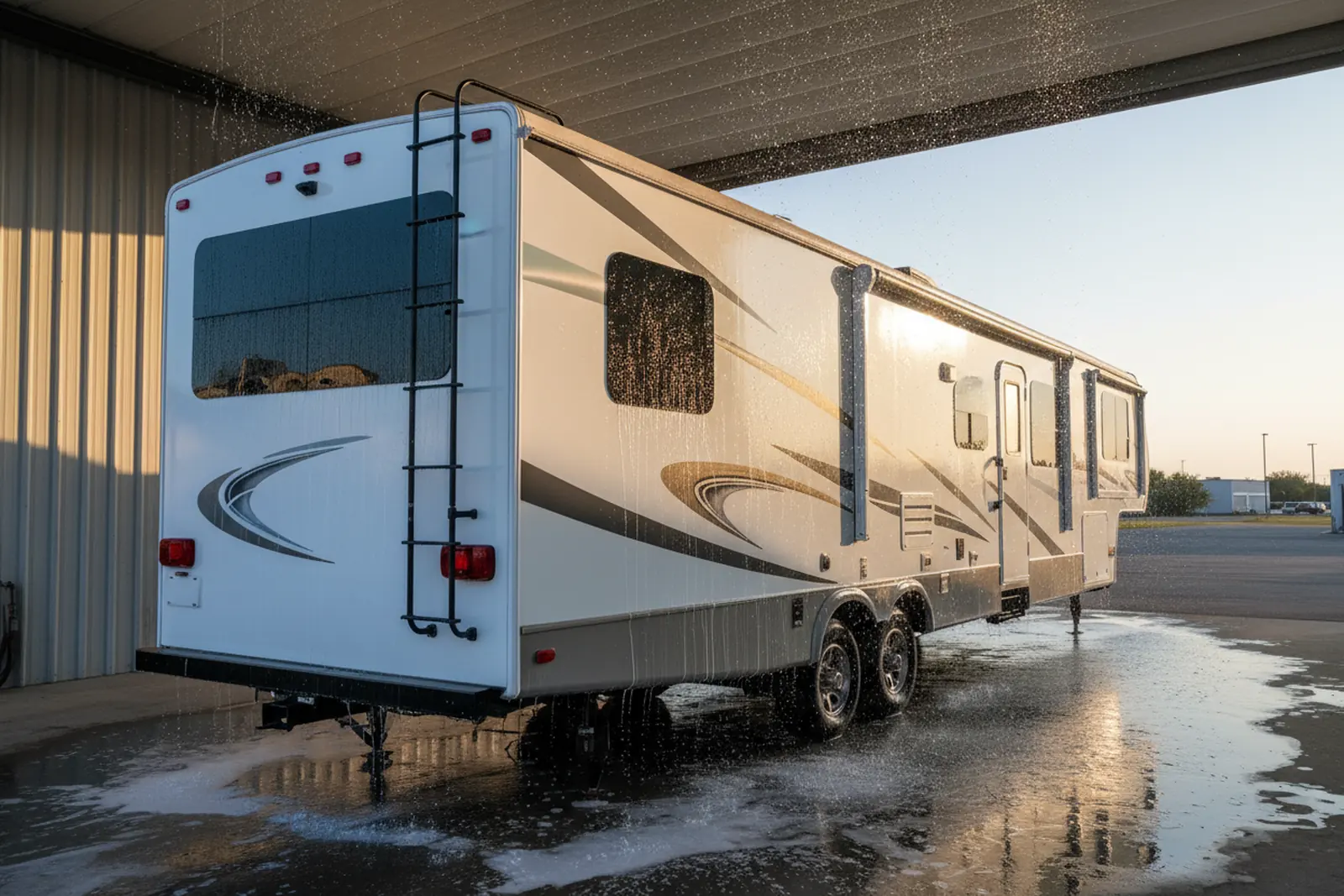
When you can’t wash it yourself, call a mobile detailer to learn how to wash an RV
Some campgrounds ban washing, period.
A mobile detailer’s wash-only price offen runs about $3 to $5 per linear foot, and a wash-and-wax often runs about $10 to $16 per foot, but rates vary by region and rig size. My coach is 40 feet, so a wash-and-wax at $12 a foot woudl be about $480.
If you do call one, ask three questions: Do you reclaim water? Do you use a pH-neutral soap? How do you protect the decals?
If you’d rather watch someone else do it first, this video shows what to watch out for.
A small test for this weekend, and a price challenge
Run your hand over the clean sidewall near the door.
Here’s what I wish I’d done in Nevada: I should of called two mobile RV detailers and asked for a written per-foot quote on a wash-and-wax before I ever pulled a hose.
Do this: pull up the mobile detailer page and ask two of them for a written quote on the same job, including roof cleaning and spot-free rinse.
More from the wash bay
FAQ
How long does it take to wash an RV?
A 25-foot travel trailer takes about two hours with setup and teardown, and my 40-foot Class A takes three to four hours. Ladder work and wheel wells add time. A first wash after a long trip with bugs and road grime can take half a day, especially if you're chasing black streaks.
Can I use dish soap to wash my RV?
No. Dish soap strips wax and can dull gelcoat over time. The sidewall panel maker's care sheet warns against harsh detergents. Use a pH-neutral wash soap made for vehicles. It costs more, but it keeps the wax protection on your finish and saves you a re-wax job.
How much does it cost to have an RV washed by a mobile detailer?
Wash-only service runs about $3 to $5 per linear foot, and a wash-and-wax runs about $10 to $16 per foot, depending on the region and rig size. Some premium washes that include roof cleaning and spot-free rinse run about $10 per foot. Get a written per-foot quote, and ask about water reclaim and decal protection.
Should I pressure wash my RV?
Only on low pressure and never near decals, seals or the roof membrane. A graphics maker's bulletin says no closer than 12 inches and no more than 1,200 psi on decals, or the vinyl warranty is void. For most of the coach, a hose with a fan nozzle is safer and gets the same result.
How do I avoid water spots on my RV after washing?
Dry the coach with a clean microfiber towel right after the final rinse, or use a spot-free rinse filter that removes dissolved minerals. Hard water spots are calcium and lime left when drops dry. A TDS meter tells you how hard your water is; the higher the reading, the more likely you'll get spots.
Why do I have to rinse the roof first?
If you wash the sidewalls first, dust and roof dirt will run down onto them and you'll wash twice. Rinsing the roof first sends the loose dirt down the gutters and away from the paint. Also clean the gutters and drip spouts while you're up there, or you'll get black streaks the next time it rains.
What is water reclaim, and do I need it?
Water reclaim is a system some mobile detailers use to capture wash water and send it to the sanitary sewer, rather than letting it run into a storm drain. Some cities, HOAs and campgrounds require it. If you're washing in a parking lot or a storage yard with no drain, check local rules; hiring a detailer with reclaim may be required.
Find RV detailers near you
Compare RV detailers and mobile washes in your city, then ask a few for a price.
Browse by stateOr jump to: RV wax & oxidation removal · Albuquerque, NM · Fort Walton Beach, FL · Sarasota, FL