What's safe on your RV? The surface-by-cleaner compatibility chart
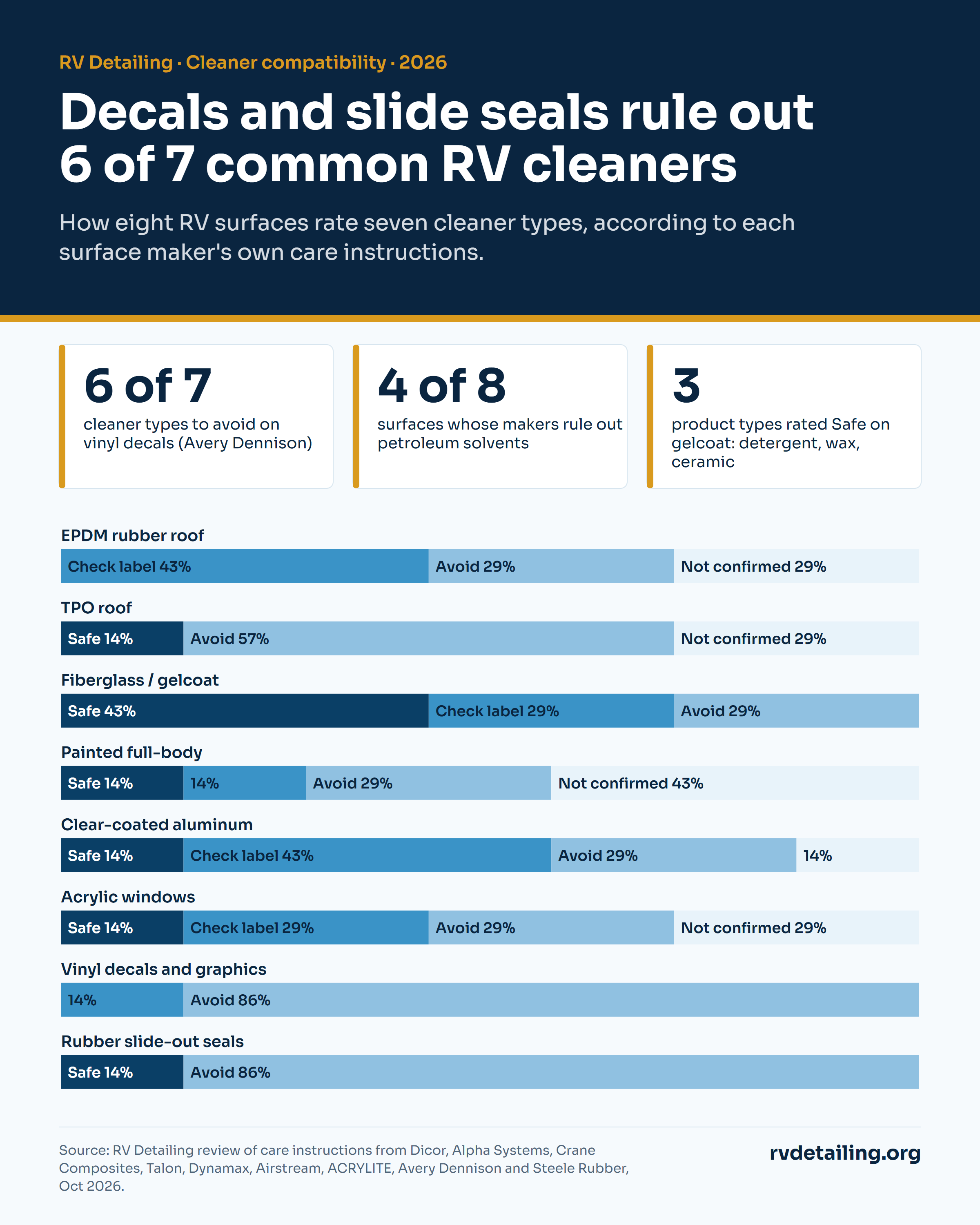
We read the care instructions published by the companies that make RV roof membranes, gelcoat sidewalls, aluminum shells, acrylic windows, vinyl graphics and slide-out seals, and charted seven common cleaner types against eight surfaces. Mild soap and wax are the most widely accepted, rated Safe on four and three surfaces, while vinyl decals and rubber seals rule out six of the seven.
By the RV Detailing research desk · Published October 25, 2026
Key findings
- Decals and slide-out seals are the pickiest surfaces. Avery Dennison and Steele Rubber each rule out 6 of the 7 product types we checked; Steele says to use only soap and water on its seals.
- Gelcoat tolerates the most. Crane Composites and Talon Products approve mild detergent, wax and (Talon) ceramic coating, and allow solvents and fine compound with care. Only ammonia and caustic cleaners are out.
- Petroleum solvents are out on both roof types. Alpha Systems says petroleum distillates will damage its TPO membrane; Dicor says petroleum solvents and citric cleaners can cause irreparable damage to EPDM and may void the warranty, allowing mineral spirits only on a cloth for a single stain.
- Dish soap splits the makers. Alpha Systems names dish soap for its TPO roof, but Dynamax says no dish soap on full-body paint and Avery Dennison says no household dishwashing detergent on vinyl graphics.
- Bleach is a no on paint and aluminum. Dicor's own mold instructions, which use Tilex on rubber roofs, say to keep it off painted and aluminum surfaces and wipe drips at once.
The chart
Each row is a surface and each column a type of cleaner. Safe means the maker recommends it or names it as acceptable. Avoid means the maker says not to use it, or says to use nothing but soap and water. Check label means the maker allows it only in a limited way, such as a spot treatment, a membrane-specific product or a fine compound for a weathered finish. Not confirmed means we found no guidance from that maker either way.
| EPDM rubber roof | Avoid | Not confirmed | Check label | Avoid | Check label | Check label | Not confirmed | Dicor care sheet, Dicor mold sheet |
| TPO roof | Avoid | Not confirmed | Not confirmed | Avoid | Safe | Avoid | Avoid | Alpha Systems, Superflex TPO sheet, Dicor |
| Fiberglass / gelcoat | Check label | Avoid | Avoid | Check label | Safe | Safe | Safe | Crane Composites, Talon Products |
| Painted full-body | Not confirmed | Not confirmed | Avoid | Check label | Avoid | Safe | Not confirmed | Dynamax paint care, Dicor mold sheet |
| Clear-coated aluminum | Check label | Not confirmed | Avoid | Avoid | Check label | Safe | Check label | Airstream, Airstream soap and polish |
| Acrylic windows | Check label | Avoid | Not confirmed | Avoid | Safe | Check label | Not confirmed | ACRYLITE care guide |
| Vinyl decals and graphics | Avoid | Avoid | Avoid | Avoid | Avoid | Avoid | Check label | Avery Dennison IB 1.8 |
| Rubber slide-out seals | Avoid | Avoid | Avoid | Avoid | Safe | Avoid | Avoid | Steele Rubber Products |
Compiled October 25, 2026. Your own RV maker's manual and the product label come first; when they disagree with this chart, follow them. Download this table (CSV)
What each maker actually says
The chart compresses a lot of fine print. These are the instructions behind each row, in the makers' own terms.
| EPDM rubber roof | Clean at least four times a year. No cleaners or conditioners with petroleum solvents, harsh abrasives or citric-based cleaners. Mineral spirits only on a dampened cloth for a stubborn stain, never over a large area. For mold, Tilex on 2 ft x 2 ft patches, rinsed off, kept off painted and aluminum surfaces. | Dicor |
| TPO roof | Non-abrasive household cleaner such as dish soap (Top Job or Spic-N-Span on Superflex) and a medium brush, three to four times a year. No acetone or anything with petroleum distillates. The membrane needs no UV or ozone protectant, and those products can often damage it. | Alpha Systems |
| Fiberglass / gelcoat | Wash at least monthly with a mild liquid detergent. Avoid abrasive, caustic (high-pH) and ammonia cleaners, which can cause discoloration, loss of gloss and reduced UV resistance. Wax once or twice a year; compound only a badly weathered surface. | Crane Composites |
| Painted full-body | Clear water only on fresh refinish paint for the first 4 to 6 weeks. Then a mild car wash shampoo safe for clear coat. No dish soap, degreasing detergents or industrial cleaners, and no brushes of any kind on paint. | Dynamax |
| Clear-coated aluminum | Abrasive polishes and cleaning solvents such as automatic dishwasher or acid etch cleaners should never be used. Mild non-abrasive soap, then a non-abrasive automotive paste or liquid wax. A small amount of kerosene on a rag for leftover asphalt spots. | Airstream |
| Acrylic windows | Mild soap or detergent and lukewarm water, light pressure. Hexane, aliphatic naphtha or kerosene for grease or tar. Do not use window cleaning sprays, kitchen scouring compounds, acetone, gasoline, benzene, alcohol or lacquer thinner, which can scratch or craze the sheet. | ACRYLITE |
| Vinyl decals and graphics | A dedicated vehicle wash, pH 5 to 9, free of abrasives, added waxes or polishes, alcohol, acids, ammonia, chlorine, glycol ethers, petroleum distillates and phosphates. No household dishwashing detergent. No polish or cutting agents. | Avery Dennison |
| Rubber slide-out seals | Only soap and water, then pat dry. Seal protectants and coatings expose the rubber to chemicals and can lead to drying and cracking. | Steele Rubber Products |
How many cleaners each surface tolerates
What it means for you
- Use two buckets of soap, not one. A mild RV or car wash soap works on gelcoat, paint, aluminum and acrylic. The roof gets a membrane cleaner that is free of petroleum distillates and citrus. See our RV roof cleaning listings.
- Read the back of the bottle for three words: petroleum distillates, citrus (or d-limonene) and ammonia. Any one of them rules a product out for at least two surfaces in this chart.
- Keep tar and bug removers on a rag. Every maker that allows a solvent at all allows it only on a small spot, tested first.
- Wax the sidewalls, not the decals or the seals. Avery Dennison wants no wax or polish on its films, and Steele wants nothing but soap on its seals. Mask them off or wipe them clean before you buff. A wax and oxidation removal pro will usually do this as part of the job.
- New paint gets clear water only. Dynamax asks for 4 to 6 weeks of plain water on fresh refinish paint while it cures.
- When in doubt, hire it out. A mobile RV detailer brings the right product for each surface, and a ceramic coating installer can tell you which panels a coating should skip.
Weather sets how often you need any of this. See the bug, sap, salt and pollen calendar for when to wash, UV exposure by state for how often to wax, and the hard water map if your rinse water leaves spots. Before you wash in the driveway, check the local runoff and drought rules.
The infographic
Free to use with a link. Publish the graphic or the numbers anywhere, as long as you credit RV Detailing with a link to this page.
How we did this
- We read care and maintenance instructions published by the makers of each surface: Dicor (EPDM roofing and roof cleaner), Alpha Systems (TPO roofing, including its Superflex TPO membrane), Crane Composites and Talon Products (gelcoat sidewall panels), Dynamax (full-body paint), Airstream (clear-coated aluminum), ACRYLITE (acrylic sheet), Avery Dennison (vehicle graphics films) and Steele Rubber Products (slide-out seals). Several are hosted on Forest River's component manual library. The chart was compiled on October 25, 2026.
- Each cell records what that maker says, not our opinion. Where a maker allows a product only for a spot treatment, only as its own branded product, or only after testing, we wrote Check label. Where a maker says to use only soap and water (Steele) we marked every other product type Avoid.
- Some cells rest on a related instruction rather than a direct mention. Gelcoat bleach is Avoid because Crane and Talon rule out caustic, high-pH cleaners, and household chlorine bleach is alkaline. Acrylic ammonia is Avoid because ACRYLITE rules out window cleaning sprays, which commonly contain ammonia. Paint and aluminum bleach are Avoid because Dicor's mold instructions say the bleach-based cleaner it names must not touch painted or aluminum surfaces.
- Where we found nothing from the maker, the cell says Not confirmed. We did not fill gaps from forum posts or retailer copy.
- Different brands of the same material can differ. The RV maker's owner's manual and the product label take priority over this chart.
Sources
- Dicor, Brite-Ply and Brite-TEK roof care and maintenance (Forest River library), accessed October 25, 2026
- Dicor, Cleaning mold and/or mildew from rubber roofing (Forest River library), accessed October 25, 2026
- Dicor Products, Rubber Roof Cleaner product page, accessed October 25, 2026
- Alpha Systems, Cleaning and maintaining your Alpha Systems roof membrane, accessed October 25, 2026
- Alpha Systems, Cleaning and maintaining the Superflex roof membrane, accessed October 25, 2026
- Crane Composites, Recreational Vehicle Care and Maintenance (Form 6998), accessed October 25, 2026
- Crane Composites, Gel-Coat Chalking (Form 7684), accessed October 25, 2026
- Talon Products, Care and Maintenance of Sidewalls, accessed October 25, 2026
- Dynamax, Paint Care and Maintenance, accessed October 25, 2026
- Airstream Support, Are there any tips for washing travel trailers?, accessed October 25, 2026
- Airstream Support, How should I clean the exterior of my Airstream travel trailer?, accessed October 25, 2026
- ACRYLITE, Caring and cleaning of ACRYLITE acrylic sheet, accessed October 25, 2026
- Avery Dennison, Instructional Bulletin 1.8: Vehicle Wrap and Graphics Maintenance, Rev. 2 (Feb 2022), accessed October 25, 2026
- Steele Rubber Products, RV Slide Out Mistakes to Avoid, accessed October 25, 2026
Cite this: RV Detailing, "What's safe on your RV? The surface-by-cleaner compatibility chart," October 25, 2026, https://rvdetailing.org/rv-cleaner-compatibility-chart/
Spotted an error or have newer data? Tell us and we'll check it and update the page.
Questions people ask
Can I use Dawn dish soap on my RV?
It depends on the surface. Alpha Systems names dish soap as a cleaner for its TPO roof membrane and Steele says soap and water for slide seals. But Dynamax says no dish soap on full-body paint, and Avery Dennison says no household dishwashing detergent on vinyl graphics. Use a vehicle wash soap on painted and decaled panels.
What cleaners damage an RV rubber roof?
Dicor, which makes EPDM roofing, says not to use cleaners or conditioners that contain petroleum solvents, harsh abrasives or citric-based ingredients, and warns they can cause irreparable damage and void the warranty. Mineral spirits are allowed only on a dampened cloth for a single stubborn stain.
Is it safe to wax RV decals?
Avery Dennison, a major maker of vehicle graphics film, says the wash you use should contain no added waxes or polishes and that polish or cutting agents will abrade and scratch the film. It allows only specialized protectants free of solvents, ammonia and similar chemicals, tested on a hidden spot first.
Should I put protectant on my RV slide-out seals?
Steele Rubber Products, which makes slide-out seals, says to clean them with only soap and water and pat them dry. It says seal protectants and coatings expose the rubber to chemicals that can lead to drying and cracking. Other seal makers sell conditioners, so check the maker of your seals.
Can I use Windex on RV windows?
Not on acrylic windows. ACRYLITE, a maker of acrylic sheet, says not to use window cleaning sprays, scouring compounds or solvents such as acetone, alcohol or gasoline, because they can scratch the surface or cause fine cracks called crazing. Use mild soap and lukewarm water with a soft cloth.