How fast will your RV oxidize? New Mexico gets 1.7 times the UV of Vermont
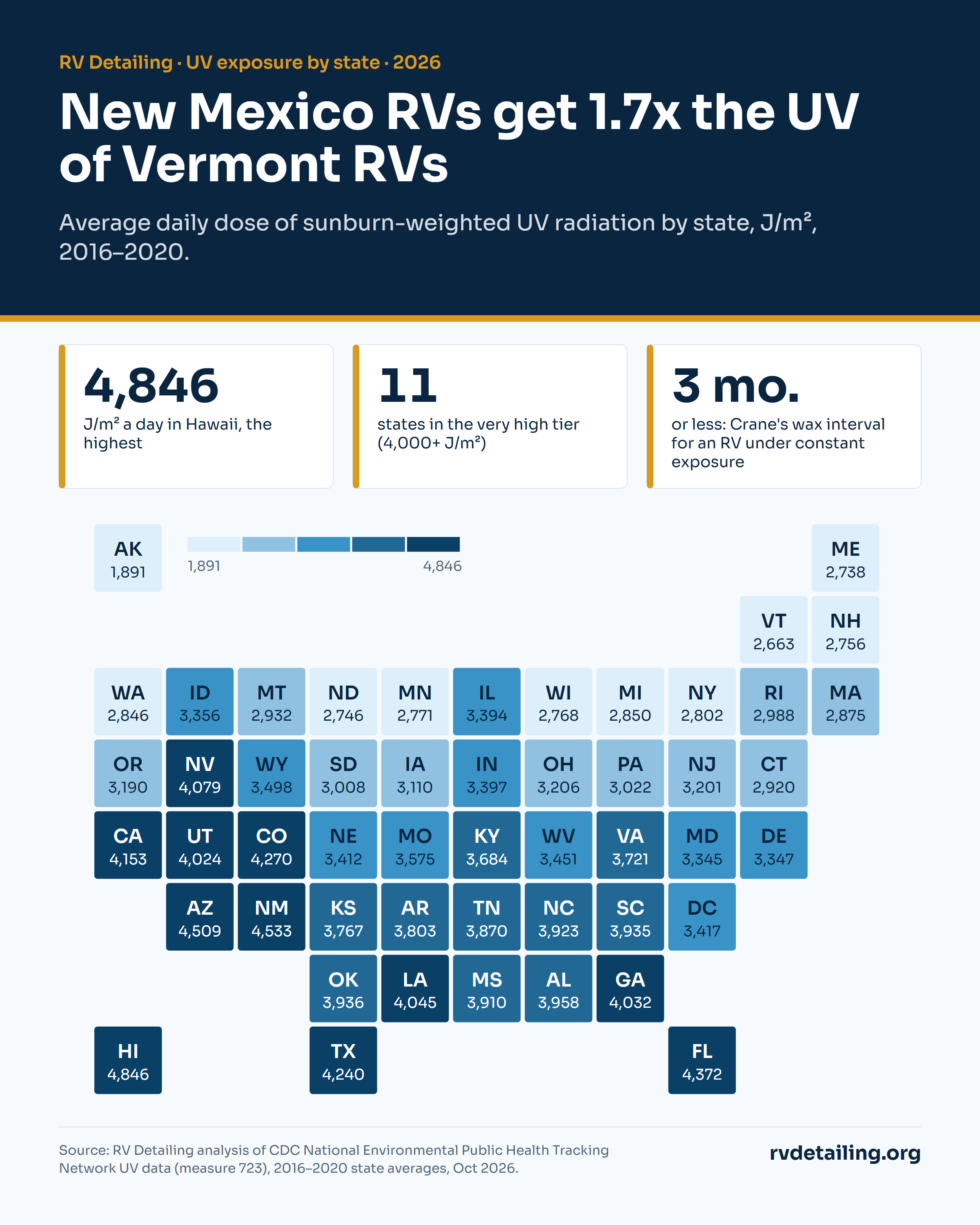
We pulled the CDC's annual average daily UV dose for every state, 2016 to 2020, and sorted states into four UV tiers. In the lower 48, New Mexico gets 1.7 times the daily UV of Vermont; Hawaii tops the list at 4,846 J/m². We paired the tiers with the gelcoat makers' own wax intervals.
By the RV Detailing research desk · Published October 25, 2026
Key findings
- Hawaii, New Mexico and Arizona get the most UV: 4,846, 4,533 and 4,509 J/m² a day on average, 2016 to 2020.
- 1.7x across the lower 48. New Mexico averages 4,533 J/m² a day; Vermont averages 2,663. Alaska is lowest overall at 1,891.
- 11 states fall in our very high tier (4,000 J/m² or more): Hawaii, New Mexico, Arizona, Florida, Colorado, Texas, California, Nevada, Louisiana, Georgia, Utah.
- Gelcoat makers tie wax frequency to exposure. Crane Composites says maintenance runs from every 6 months to every 3 months or less for an RV kept out in the elements, and its warranty requires a wash and wax at least every 6 months (3 months or less for dark colors).
- The national median is 3,412 J/m². Half the states, mostly in the South and West, sit above it.
UV dose by state
The map shows the average daily dose of sunburn-weighted UV radiation reaching the ground in each state, averaged over 2016 to 2020. Darker tiles mean more UV. It is the same measure the CDC uses to study skin cancer risk, and it tracks the sunlight that fades and chalks an RV's gelcoat and paint.
Why sun turns an RV chalky
Fiberglass RV sidewalls are faced with gelcoat. Crane Composites, which makes Filon and Noble composite panels and describes their exterior surface as a high-quality gelcoat, puts it plainly: "Sunlight, heat and moist air combine to oxidize the gelcoat surface, fading it and making the surface cloudy." Talon Products, another sidewall maker, calls this oxidation and notes that darker colors tend to be more susceptible.
Both companies say the cure is the same: wash often, wax on a schedule and store out of the sun when you can. Crane says regular waxing reduces surface deterioration caused by air pollutants, prolonged sunlight and moisture. Talon recommends a wash and wax at least every six months, more often for darker units, and suggests alternating parking positions so one side doesn't take all the sun. Once a finish has gone chalky, both makers say it takes a polishing or rubbing compound to cut back to fresh gelcoat, followed by wax (Crane) or a ceramic coating (Talon).
A wax schedule by UV tier
Crane Composites gives a range: maintenance of the gelcoat "can be as little as every 6 months to as often as every 3 months or less, if the vehicle is kept out in the elements under constant exposure." Its gelcoat warranty sets a floor of a wash and wax every 6 months, or every 3 months or less for darker colors. We spread that range across the four UV tiers below. This is our guidance, built from the makers' range, not a manufacturer rule.
| Very high | 4,000 or more | 11 | Every 3 months |
| High | 3,500 to 3,999 | 11 | Every 3 to 4 months |
| Moderate | 3,000 to 3,499 | 15 | Every 4 to 6 months |
| Lower | Under 3,000 | 14 | Every 6 months |
Crane's 6-month minimum applies everywhere. Shorten the interval for dark gelcoat or paint, and stretch it toward 6 months if the RV is stored indoors or under a roof. Download this table (CSV)
Every state, ranked
| 1 | Hawaii | 4,846 | Very high | Every 3 months |
| 2 | New Mexico | 4,533 | Very high | Every 3 months |
| 3 | Arizona | 4,509 | Very high | Every 3 months |
| 4 | Florida | 4,372 | Very high | Every 3 months |
| 5 | Colorado | 4,270 | Very high | Every 3 months |
| 6 | Texas | 4,240 | Very high | Every 3 months |
| 7 | California | 4,153 | Very high | Every 3 months |
| 8 | Nevada | 4,079 | Very high | Every 3 months |
| 9 | Louisiana | 4,045 | Very high | Every 3 months |
| 10 | Georgia | 4,032 | Very high | Every 3 months |
| 11 | Utah | 4,024 | Very high | Every 3 months |
| 12 | Alabama | 3,958 | High | Every 3 to 4 months |
| 13 | Oklahoma | 3,936 | High | Every 3 to 4 months |
| 14 | South Carolina | 3,935 | High | Every 3 to 4 months |
| 15 | North Carolina | 3,923 | High | Every 3 to 4 months |
| 16 | Mississippi | 3,910 | High | Every 3 to 4 months |
| 17 | Tennessee | 3,870 | High | Every 3 to 4 months |
| 18 | Arkansas | 3,803 | High | Every 3 to 4 months |
| 19 | Kansas | 3,767 | High | Every 3 to 4 months |
| 20 | Virginia | 3,721 | High | Every 3 to 4 months |
| 21 | Kentucky | 3,684 | High | Every 3 to 4 months |
| 22 | Missouri | 3,575 | High | Every 3 to 4 months |
| 23 | Wyoming | 3,498 | Moderate | Every 4 to 6 months |
| 24 | West Virginia | 3,451 | Moderate | Every 4 to 6 months |
| 25 | District of Columbia | 3,417 | Moderate | Every 4 to 6 months |
| 26 | Nebraska | 3,412 | Moderate | Every 4 to 6 months |
| 27 | Indiana | 3,397 | Moderate | Every 4 to 6 months |
| 28 | Illinois | 3,394 | Moderate | Every 4 to 6 months |
| 29 | Idaho | 3,356 | Moderate | Every 4 to 6 months |
| 30 | Delaware | 3,347 | Moderate | Every 4 to 6 months |
| 31 | Maryland | 3,345 | Moderate | Every 4 to 6 months |
| 32 | Ohio | 3,206 | Moderate | Every 4 to 6 months |
| 33 | New Jersey | 3,201 | Moderate | Every 4 to 6 months |
| 34 | Oregon | 3,190 | Moderate | Every 4 to 6 months |
| 35 | Iowa | 3,110 | Moderate | Every 4 to 6 months |
| 36 | Pennsylvania | 3,022 | Moderate | Every 4 to 6 months |
| 37 | South Dakota | 3,008 | Moderate | Every 4 to 6 months |
| 38 | Rhode Island | 2,988 | Lower | Every 6 months |
| 39 | Montana | 2,932 | Lower | Every 6 months |
| 40 | Connecticut | 2,920 | Lower | Every 6 months |
| 41 | Massachusetts | 2,875 | Lower | Every 6 months |
| 42 | Michigan | 2,850 | Lower | Every 6 months |
| 43 | Washington | 2,846 | Lower | Every 6 months |
| 44 | New York | 2,802 | Lower | Every 6 months |
| 45 | Minnesota | 2,771 | Lower | Every 6 months |
| 46 | Wisconsin | 2,768 | Lower | Every 6 months |
| 47 | New Hampshire | 2,756 | Lower | Every 6 months |
| 48 | North Dakota | 2,746 | Lower | Every 6 months |
| 49 | Maine | 2,738 | Lower | Every 6 months |
| 50 | Vermont | 2,663 | Lower | Every 6 months |
| 51 | Alaska | 1,891 | Lower | Every 6 months |
Source: CDC National Environmental Public Health Tracking Network, measure 723 (annual average daily dose of UV irradiance), mean of 2016–2020 state values. Download this table (CSV)
What it means for you
- Find your tier, then put the wax dates on the calendar. In the very high tier, an RV that lives outside needs wax about four times a year. A wax and oxidation removal shop can set you up on a schedule.
- Already chalky? Wax won't fix it. Both sidewall makers say a weathered finish needs compound first. That is a job for an oxidation removal pro with a buffer.
- A ceramic coating is the longer-lasting option. Talon Products names a ceramic coating as the seal after compounding. Compare RV ceramic coating installers in your area.
- Shade is the cheapest protection. Crane calls indoor storage ideal and recommends outdoor storage out of direct sunlight; if you use a cover, pick one that doesn't trap moisture.
- Aluminum needs it too. Airstream says a non-abrasive wax increases the life of a clear-coated finish. See Airstream and aluminum polishing.
- Check what's safe before you buy product. Our cleaner compatibility chart lists what each surface maker allows.
Sun is one of several seasonal hazards. The bug, sap, salt and pollen calendar covers the rest, and the hard water map explains why a wash in some states leaves spots.
The infographic
Free to use with a link. Publish the graphic or the numbers anywhere, as long as you credit RV Detailing with a link to this page.
How we did this
- UV data come from the CDC National Environmental Public Health Tracking Network, measure 723, "Annual Average Daily Dose of UV Irradiance (J/m²)", state level. We downloaded the 2016–2020 values for all 50 states and DC through the Tracking Network's public API on October 25, 2026, and averaged the five years for each state.
- The measure is the erythemally weighted daily dose: the UV energy reaching the ground over a day, weighted by its power to cause sunburn. The CDC's methods for the underlying county data are described in Zhou et al., Environmental Pollution, 2019.
- We set four tiers at round numbers (4,000, 3,500 and 3,000 J/m²). They are our cut points, not CDC categories.
- The wax intervals are our guidance. They spread Crane Composites' published range (every 6 months down to every 3 months or less for constant outdoor exposure) across the tiers. No manufacturer publishes a UV-indexed schedule.
- UV varies within a state, especially with altitude and between coast and mountains. A single state average hides that.
Sources
- CDC National Environmental Public Health Tracking Network, Data Explorer: Sunlight & UV, accessed October 25, 2026
- CDC Tracking Network API, measure 723 state values, 2016–2020, accessed October 25, 2026
- Zhou Y, et al. Compilation and spatio-temporal analysis of publicly available total solar and UV irradiance data in the contiguous United States. Environmental Pollution 2019;253:130–40, accessed October 25, 2026
- Crane Composites, Recreational Vehicle Care and Maintenance (Form 6998), accessed October 25, 2026
- Crane Composites, Gel-Coat Chalking (Form 7684), accessed October 25, 2026
- Talon Products, Care and Maintenance of Sidewalls, accessed October 25, 2026
- Airstream Support, Are there any tips for washing travel trailers?, accessed October 25, 2026
Cite this: RV Detailing, "How fast will your RV oxidize? New Mexico gets 1.7 times the UV of Vermont," October 25, 2026, https://rvdetailing.org/rv-uv-oxidation-risk-by-state/
Spotted an error or have newer data? Tell us and we'll check it and update the page.
Questions people ask
Which state is hardest on an RV's finish from sun?
By UV dose, Hawaii is highest at 4,846 J/m² a day, followed by New Mexico (4,533) and Arizona (4,509), based on CDC data for 2016 to 2020. Crane Composites says heat and moist air also drive gelcoat oxidation, which UV numbers alone don't capture.
How often should I wax my RV?
Crane Composites, a major gelcoat sidewall maker, says every 6 months at minimum and every 3 months or less for an RV kept outdoors under constant exposure or for dark colors. Our guidance is every 3 months in very high UV states, 3 to 4 in high, 4 to 6 in moderate and 6 in lower UV states.
What causes RV oxidation?
Crane Composites says sunlight, heat and moist air combine to oxidize the gelcoat surface, fading it and making it cloudy. Talon Products adds that darker colors tend to be more susceptible and that more exposure means more frequent maintenance.
Can wax remove oxidation from an RV?
Not once it is chalky. Crane says a badly weathered surface needs polishing or rubbing compound to remove the weathered layer, followed by wax. Talon recommends a polishing compound followed by a ceramic coating. Wax on its own protects a finish that is still in good shape.