Hard water spot risk map: groundwater in 21 states tests very hard
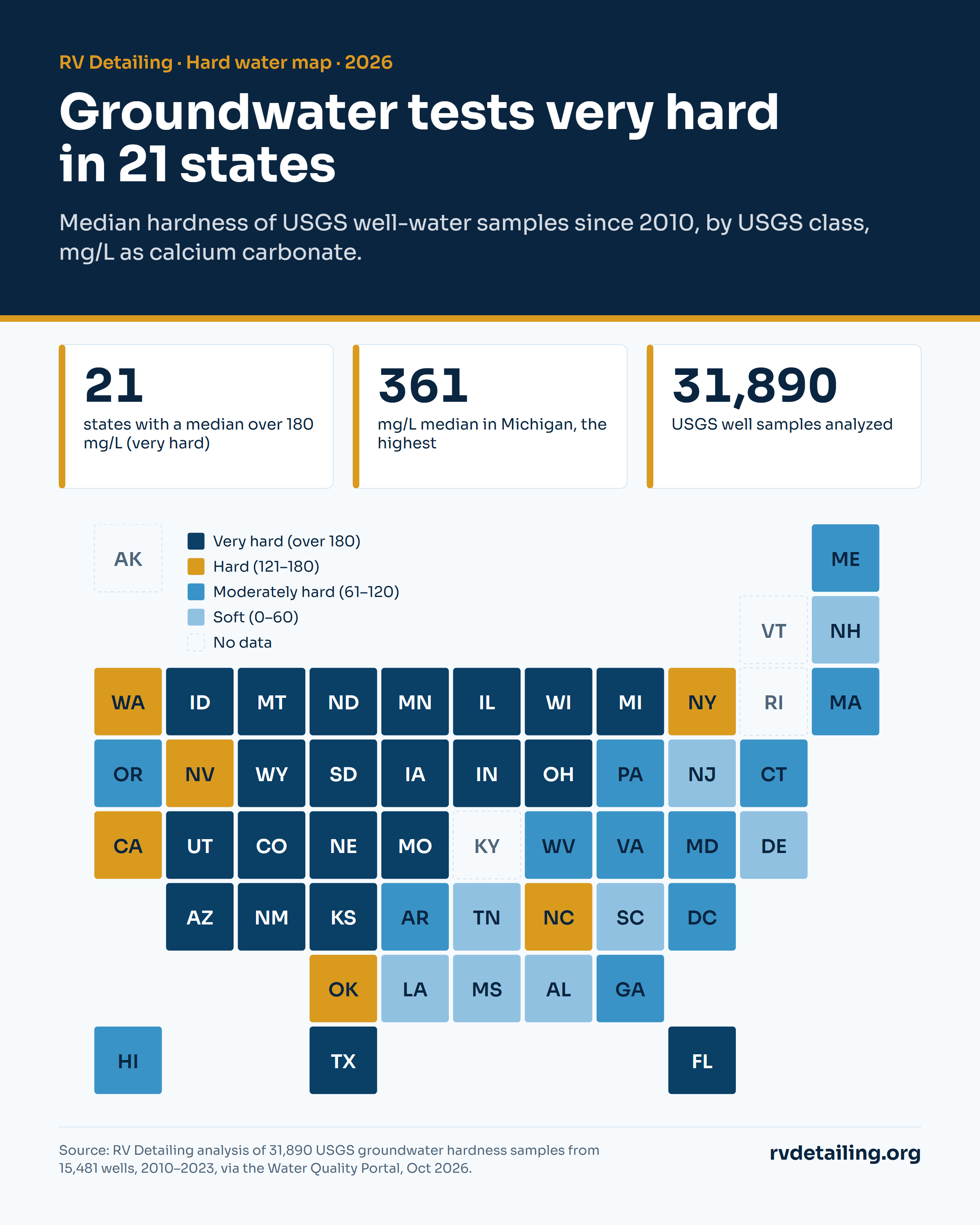
We pulled every USGS groundwater hardness test since 2010 from the national Water Quality Portal, 31,890 samples from 15,481 wells, and classed each state by its median using USGS's own scale. 21 states come out very hard, led by Michigan and Ohio. We added the tap water hardness reported by seven big-city utilities.
By the RV Detailing research desk · Published October 25, 2026
Key findings
- 21 of the 46 states and DC we could classify have very hard groundwater by USGS's scale (over 180 mg/L as calcium carbonate), based on the median of USGS well samples since 2010.
- The Midwest is the hardest. Michigan (361 mg/L), Ohio (360), Missouri (348) and Illinois (344) top the list.
- 8 states test soft (60 mg/L or less), in the Southeast (Alabama, Louisiana, Mississippi, South Carolina and Tennessee) plus New Jersey, Delaware and New Hampshire.
- City tap water ranges more than 30-fold. Portland's Bull Run supply runs 7 to 11 mg/L; San Antonio's utility reports 15 to 20 grains per gallon, about 257 to 342 mg/L.
- Drying is the fix makers name. Dynamax, Airstream and ACRYLITE all tell owners to dry with a chamois or soft cloth, and Crane and Dynamax say not to wash in direct sun.
The map
Hard water carries dissolved calcium and magnesium. When a rinse dries on an RV, the water leaves and the minerals stay, as white spots on gelcoat, paint, glass and aluminum. USGS classes water by how much of those minerals it holds, measured as calcium carbonate: 0 to 60 mg/L is soft, 61 to 120 moderately hard, 121 to 180 hard and more than 180 very hard.
Tap water in seven big cities
| San Antonio, TX | 257–342 (15–20 gpg) | 300 | Very hard | SAWS water quality FAQ |
| San Diego, CA | 237–243 (plant averages, 2025) | 240 | Very hard | City of San Diego 2025 report |
| Phoenix, AZ | 172–302 (2025 range) | 237 | Hard to very hard | City of Phoenix water quality report |
| Tampa, FL | 211 (2025 average) | 211 | Very hard | Tampa Water Department 2025 report |
| Denver, CO | 105 (2025 average; range 55–124) | 105 | Moderately hard | Denver Water 2026 report |
| Austin, TX | 93 (2025 average; range 70–126) | 93 | Moderately hard | Austin Water 2025 report |
| Portland, OR | 7–11 (Bull Run supply) | 9 | Soft | Portland Water Bureau 2026 report |
Typical is the utility's average, or the midpoint of the range it reports. Grains per gallon converted at 17.1 mg/L per grain, the factor Austin Water publishes. Ranges reflect different treatment plants and seasons. Download this table (CSV)
Every state
| Michigan | 361 | 151 | Very hard |
| Ohio | 360 | 129 | Very hard |
| Missouri | 348 | 176 | Very hard |
| Illinois | 344 | 195 | Very hard |
| Nebraska | 330 | 278 | Very hard |
| Colorado | 327 | 298 | Very hard |
| Montana | 326 | 265 | Very hard |
| Indiana | 320 | 106 | Very hard |
| North Dakota | 314 | 180 | Very hard |
| Utah | 305 | 593 | Very hard |
| Minnesota | 304 | 171 | Very hard |
| Iowa | 281 | 115 | Very hard |
| Kansas | 276 | 231 | Very hard |
| South Dakota | 275 | 61 | Very hard |
| Florida | 272 | 420 | Very hard |
| Wisconsin | 272 | 178 | Very hard |
| New Mexico | 243 | 491 | Very hard |
| Texas | 222 | 761 | Very hard |
| Arizona | 213 | 172 | Very hard |
| Idaho | 184 | 890 | Very hard |
| Wyoming | 182 | 369 | Very hard |
| California | 173 | 3,378 | Hard |
| Oklahoma | 167 | 127 | Hard |
| Nevada | 162 | 271 | Hard |
| New York | 146 | 824 | Hard |
| Washington | 146 | 236 | Hard |
| North Carolina | 130 | 340 | Hard |
| Connecticut | 113 | 38 | Moderately hard |
| District of Columbia | 110 | 26 | Moderately hard |
| Georgia | 106 | 235 | Moderately hard |
| West Virginia | 104 | 148 | Moderately hard |
| Virginia | 99 | 288 | Moderately hard |
| Pennsylvania | 90 | 741 | Moderately hard |
| Arkansas | 82 | 294 | Moderately hard |
| Oregon | 76 | 141 | Moderately hard |
| Massachusetts | 67 | 158 | Moderately hard |
| Maryland | 64 | 301 | Moderately hard |
| Hawaii | 63 | 23 | Moderately hard |
| Maine | 61 | 53 | Moderately hard |
| Mississippi | 60 | 141 | Soft |
| New Jersey | 55 | 517 | Soft |
| Delaware | 54 | 269 | Soft |
| New Hampshire | 47 | 26 | Soft |
| Tennessee | 47 | 157 | Soft |
| South Carolina | 24 | 110 | Soft |
| Alabama | 21 | 139 | Soft |
| Louisiana | 21 | 270 | Soft |
| Kentucky | Not confirmed | 11 | Too few wells sampled |
| Alaska | Not confirmed | 13 | Too few wells sampled |
| Vermont | Not confirmed | 5 | Too few wells sampled |
| Rhode Island | Not confirmed | 5 | Too few wells sampled |
Source: USGS samples in the Water Quality Portal (characteristic "Hardness, Ca, Mg", site type Well), retrieved October 25, 2026. Download this table (CSV)
How to wash without spots
The surface makers agree on the basics, and none of them involve a special product.
- Wash in the shade, on a cool surface. Crane Composites says not to wash and wax in direct sunlight. Dynamax asks for a surface under 90°F and out of direct sun. Airstream says to clean when the aluminum skin is cool.
- Dry it, don't let it air-dry. Dynamax warns that tap and well water contain chemicals that can water-stain a finish, and says to dry with a squeegee or a clean leather chamois. Airstream says drying with a chamois or soft cloth may prevent spots and streaks. ACRYLITE says to blot acrylic dry with a damp cloth or chamois.
- Work in sections. Airstream suggests washing one six-foot section at a time, top to bottom, so soap and water don't dry before you rinse.
- Pick a cleaner built for it. Dicor says its Rubber Roof Cleaner contains water-softening agents to combat hard water spotting. Dynamax suggests half a cup of food-grade vinegar in the wash water to help soften it.
- Use pure water for the final rinse. Deionized (DI) or reverse-osmosis water has had most dissolved minerals taken out, so a final rinse with it dries with little or nothing left behind.
How mobile detailers handle it
A mobile crew washing in your driveway or storage lot uses whatever water is on site, so in the very hard states the drying step matters most. When you book a mobile RV wash or mobile detailer, ask three things: whether they bring their own water or use yours, whether they run a spot-free (DI or RO) final rinse, and whether they hand-dry or leave it to air-dry. A crew that waxes or applies a ceramic coating afterward also gives water less to grip next time. If spots are already etched in, ask about oxidation removal and polishing.
Before washing at home, check whether your city allows driveway washing, and see what cleaners are safe on each surface. The bug, sap, salt and pollen calendar shows when you'll be washing most.
The infographic
Free to use with a link. Publish the graphic or the numbers anywhere, as long as you credit RV Detailing with a link to this page.
How we did this
- We downloaded every result for the characteristic "Hardness, Ca, Mg" at USGS (NWIS) groundwater well sites, sampled January 2010 or later, from the national Water Quality Portal on October 25, 2026, one request per state. Results run through 2023. All were reported in mg/L as calcium carbonate.
- For each well we took the median of its samples, then the median across wells in the state, so heavily sampled wells don't dominate. 47 states (counting DC) had at least 20 wells; AK, KY, RI, VT did not and are marked Not confirmed.
- States were classed with the USGS Water Science School scale: soft 0–60, moderately hard 61–120, hard 121–180, very hard over 180 mg/L.
- USGS samples wells for specific studies, not as a random survey, so a state's median reflects where USGS has worked. It describes untreated groundwater, not treated tap water.
- City figures come from each utility's latest water quality report or FAQ page, read on October 25, 2026. We converted grains per gallon at 17.1 mg/L per grain.
Sources
- USGS Water Science School, Hardness of Water, accessed October 25, 2026
- Water Quality Portal (USGS, EPA, NWQMC), Result search: Hardness, Ca, Mg, site type Well, provider NWIS, accessed October 25, 2026. Example query for one state (Michigan): https://www.waterqualitydata.us/data/Result/search?statecode=US%3A26&characteristicName=Hardness%2C%20Ca%2C%20Mg&siteType=Well&providers=NWIS&startDateLo=01-01-2010&mimeType=csv
- San Antonio Water System, Water quality FAQs, accessed October 25, 2026
- City of San Diego, 2025 Annual Drinking Water Quality Report, accessed October 25, 2026
- City of Phoenix, Water Quality Report, accessed October 25, 2026
- City of Tampa, 2025 Water Quality Report, accessed October 25, 2026
- Denver Water, 2026 Water Quality Report, accessed October 25, 2026
- Austin Water, Water Quality Reports (2025 data), accessed October 25, 2026
- Portland Water Bureau, 2026 Drinking Water Quality Report, accessed October 25, 2026
- Dynamax, Paint Care and Maintenance, accessed October 25, 2026
- Crane Composites, Recreational Vehicle Care and Maintenance, accessed October 25, 2026
- Airstream Support, Are there any tips for washing travel trailers?, accessed October 25, 2026
- Dicor Products, Rubber Roof Cleaner, accessed October 25, 2026
- ACRYLITE, Caring and cleaning of acrylic sheet, accessed October 25, 2026
Cite this: RV Detailing, "Hard water spot risk map: groundwater in 21 states tests very hard," October 25, 2026, https://rvdetailing.org/hard-water-rv-washing-map/
Spotted an error or have newer data? Tell us and we'll check it and update the page.
Questions people ask
What counts as hard water?
USGS classes water by its calcium and magnesium content, measured as calcium carbonate: 0 to 60 mg/L is soft, 61 to 120 moderately hard, 121 to 180 hard and over 180 very hard. One grain per gallon equals about 17.1 mg/L, so very hard water starts near 10.5 grains.
Which states have the hardest water?
In USGS groundwater samples since 2010, the highest state medians are Michigan (361 mg/L), Ohio (360), Missouri (348) and Illinois (344). 21 states have a median above 180 mg/L, the USGS very hard line. City tap water can differ from the state's wells.
How do I stop water spots when washing my RV?
Wash in the shade on a cool surface, work one section at a time and dry with a squeegee, chamois or soft cloth before the water evaporates. Dynamax, Airstream and Crane all give some version of that advice. A final rinse with deionized or reverse-osmosis water leaves few minerals behind.
Do mobile RV detailers use spot-free water?
Some do and some don't. A mobile crew often uses the water at your site, so ask whether they bring their own water, whether they run a deionized or reverse-osmosis final rinse and whether they hand-dry. In very hard water states, hand-drying makes the biggest difference.