How to remove black streaks from an RV and stop them coming back
By Bev Lindqvist · October 29, 2026
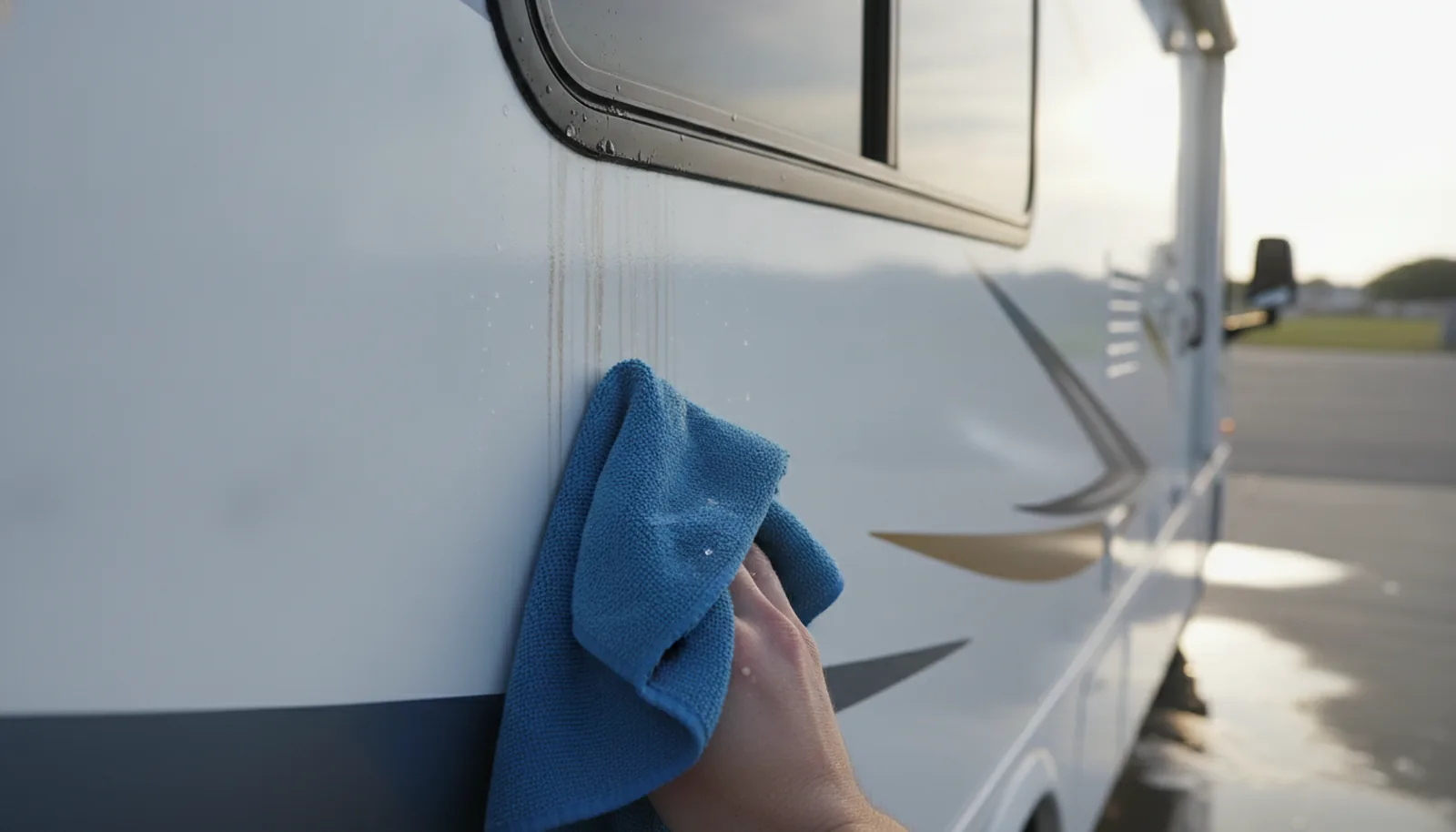
Last August I came back from a week in Tucson and found my 40-foot Class A looking like it had been crying. Black streaks ran down from every window, gutter, and the front cap, and I needed to figure out how to remove black streaks from RV sidewalls fast. One monsoon storm had done that. While I was down there I had looked into an RV wash in Tucson for future trips, and I still check mobile RV detailers in Tucson every few months. I had washed the rig two weeks before, but that desert rain pulled a winter’s worth of grime off the roof and painted it down the sides. I got on the ladder and started scrubbing, and that’s when I figured it out: if you don’t start with the roof and gutters, you’ll be doing this again after the next rain. If you’d rather not spend the weekend on a ladder, mobile RV detailers in Tucson will often quote black-streak removal line by line or as part of a wash and wax package. Same goes for trailer washing services if you have a smaller rig.
Once I fixed the spouts and waxed the sidewalls, the streaks mostly stopped. If I had a boat too, I’d look into RV and boat detailing to keep both clean. This is how I remove the ones that come back, and how I keep them from settling in the first place. Some folks prefer ceramic coating options for longer protection.
Start with the roof and gutters, or the streaks will be back after the next rain
The answer is in the heading: a dirty roof and clogged gutters are the source, and until you fix them, you’re just washing the same dirt off the sides over and over. Black streaks form when rainwater runs off the roof and thru the gutters, picking up dirt, grime, and airborne residue on the way down. If the roof is dirty, that sludge runs down the sides and dries into streaks.
My roof routine takes about 90 minutes on a 40-footer, using a long-handled brush and a rubber-roof cleaner made for my roof membrane. I scrub in small sections, about two feet by two feet, and I rinse with a hose, never a pressure washer, because high pressure can force water past seals and damage the membrane.
While I’m up there, I check the gutter spouts. Short or missing spouts mean rain pours right down the sidewalls. I added simple spout extensions that angle the runoff away from the body, and half my streak problem vanished. After one particularly ugly storm, I learned that nearby mobile RV detailers will offen do a roof wash as part of a basic exterior detail, and many will let you book just the roof if that’s all you need. It saves a lot of climbing.
Why black streaks form under windows, down the front cap, and behind the gutters
It comes down to where the water concentrates. The gutters and drip spouts concentrate the flow, so you’ll see streaks running down from every roof penetration, window corner, and seam.
Oxidized gelcoat makes it worse. The rough, chalky surface grabs that dirty water and holds it. I do the towel test once a month: wipe a clean white microfiber across the side. Powdery residue means the gelcoat needs compounding, not more washing. If the streaks sit in oxidized gelcoat, no amount of black-streak remover will get them out. I’d rather pay for correction than scrub myself into bursitis.
For the best overview of what oxidation removal and a full detail actualy include, read our post on RV detailing. It walks through the order: wash, decontaminate, compound, polish, then protect.
How to remove black streaks from RV sidewalls, step by step
Here’s the order I use on my coach, and it works on gelcoat and full-paint; for metal siding, check your RV maker’s care sheet first.
I use a black-streak remover that says it’s safe for fiberglass, gelcoat, and decals. I keep a spray bottle of a mild one, and I only use the stronger cleaner on the roof, where there’s no paint to hurt.
If the streaks are leftover from a storm last month, a mild bathroom cleaner can work on the curb side, but test it on a small area first and keep it off painted or aluminum surfaces. I wouldn’t use it near the entry door or anywhere painted, tho.
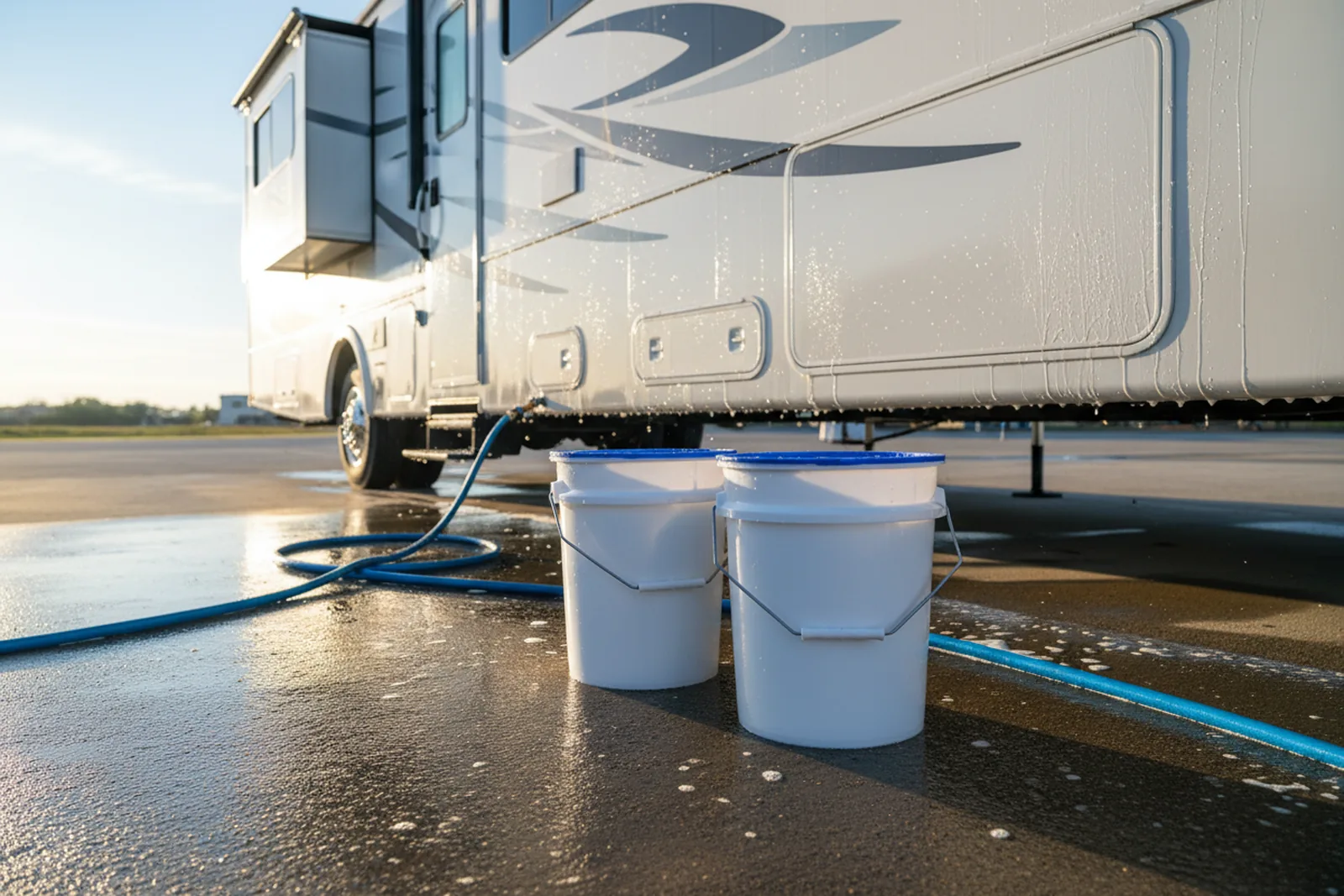
I found this video helpful when I was learning the process, it shows the same steps I use on my coach.
Step-by-step: my black streak removal routine
This is the exact order I follow, and I adjust it depending on how long the streaks have been there. 5. Re-wet the section with a clean, damp microfiber, then rinse with the the hose. I rinse twice, once with a gentle spray and once with a fan spray held at arm’s length to get the residue out of the seams, never a straight stream close to the surface. 6. Check for remaining streaks. If you see a faint brown line, don’t scrub harder. Wait until the panel is dry, then try a mild cleaner wax on a soft cloth, testing it on a small area first. 7. When the whole side is clean and dry, apply a spray wax or synthetic sealant by hand. I use a microfiber applicator and work in two-foot sections. Skip this step and the streaks will be back after the next rain. 8. Give the gutters and spout extensions a quick rinse. A clean gutter sends clean water.
The printable checklist: clean roof and gutters, then sidewalls, then protect
I keep this taped inside a cabinet by the entry door.
Roof and gutters
- [ ]
- [ ]
- [ ]
- [ ]
- [ ]
Sidewall wash
- [ ]
- [ ]
- [ ]
- Rinse each section before it dries, working bottom to top
- Wash the whole side lightly with pH-neutral soap, then rinse
Protect
- Dry with a clean chamois or microfiber
- Apply spray wax or synthetic sealant with a microfiber applicator, two-foot sections
- Buff off with a clean, dry microfiber
- Log the date and what products you used
This is the point where I mention our breakdown of RV detailing prices. If you’re paying a pro, the per-foot rate for a wash and wax usually runs about $10 to $16, and black streak removal is often included or a small add-on.
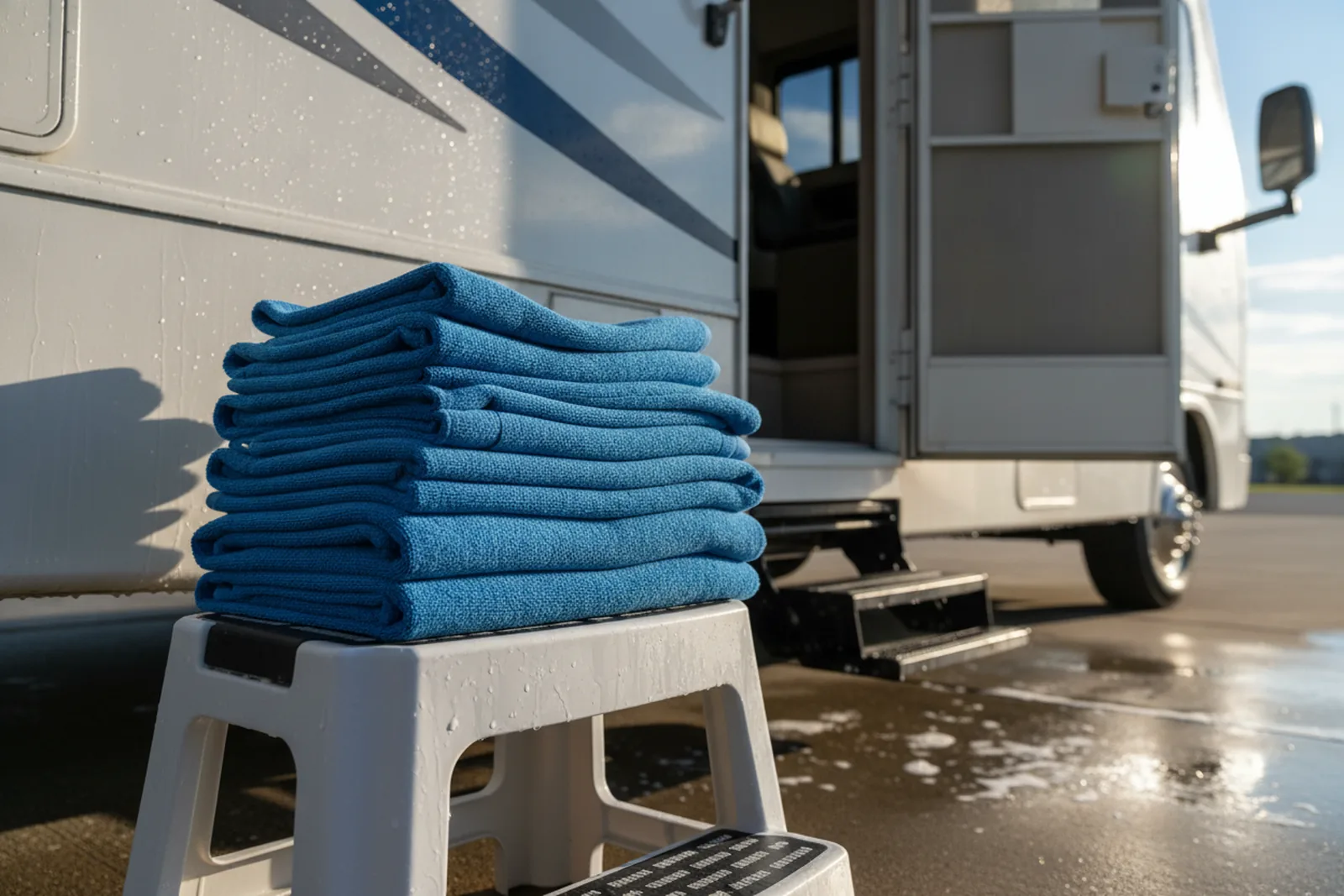
When the streaks live inside oxidized gelcoat, the real fix is compounding
If the sidewall feels chalky and the towel test comes back white, no amount of black-streak remover will do the job. If the whole side is faded, a full oxidation removal will run roughly $15 per foot for light oxidation, and $30 per foot and up for heavy correction. That’s before wax or sealant. It’s a big job, and it’s the one I’ll pay a pro to do. Compound first, protect immediately after. Compounded gelcoat has no UV protection left, and it will re-oxidize fast if you leave it bare.
Gutter spout extensions are the cheapest fix I’ve found
I bought a set of simple spout extensions at an RV parts store, the kind that snap onto the exisiting gutter spouts and angle the water outward, away from the body. They cost about fifteen dollars and took an hour to install. The next rain, the sidewalls stayed clean.
I’ve also seen RVs with gutters so clogged with pine needles the water was overflowing, not running to the spouts at all. Now I clean the gutters every time I wash, using a soft brush and a hose. Ten minutes.
The black streak test I do every month
I keep a white microfiber cloth in the driver’s door pocket. Once a month, I run it across the sidewall after a rain. A dark smudge on the cloth means the roof or gutters need cleaning. If the sidewall feels rough and the cloth comes back white and chalky, it’s oxidation, not a streak. That’s the difference between a $10 cleaner and a compounding job that can run $600 or more. I’d rather know now than argue with the shine next spring.
And if the next storm leaves my coach looking like a raccoon again, I’ll spend an hour searching trailer washing in Tucson and ask three of them for a written per-foot quote on streak removal and a wax. The one who comes back with a real plan for the roof and gutters, not just a promise of a brighter sidewall, gets the job.
Before you grab the buffer
FAQ
What are black streaks on an RV?
Black streaks are dirty rainwater that runs off the roof and gutters, carrying dust, pollen, soot, and roof grime down the sidewalls. The water evaporates and leaves a dark film. They're most common under gutter ends, roof fixtures, and windows. If the sidewall is oxidized, the chalky surface holds onto that grime, making the streaks harder to remove and more likely to reappear.
How do I remove black streaks from my RV?
Wash the roof and gutters first, then clean the sidewalls with a black-streak remover safe for fiberglass and decals. Use a soft microfiber, work in two-foot sections and never let the remover dry on the paint. Rinse each section, then apply a wax or synthetic sealant. For stubborn streaks, a mild cleaner wax can lift what a soap leaves behind.
Can I use a Magic Eraser on RV black streaks?
No. Magic Erasers and other melamine sponges are abrasive. They work by sanding off the top layer of gelcoat or paint, which removes the streak but also dulls the finish and can leave a permanently hazy spot. Use a non-abrasive black-streak remover on a soft cloth or sponge instead.
Why do black streaks come back so fast?
Because the source is still dirty. If the roof, gutters, or spout extensions carry dirty water onto the sides, the next rain will make new streaks. Oxidized gelcoat also grabs grime faster. Clean the roof and gutters at least a couple times a year, add spout extensions, and keep the sidewalls protected with a spray wax or sealant.
How much does a detailer charge to remove black streaks?
Most detailers fold streak removal into a wash or wash-and-wax package. A wash alone runs about $3 to $5 per foot of rig lenght; wash and wax runs about $10 to $16 per foot. Some charge a small add-on for heavy streaks or roof cleaning, often around $1 to $3 per foot, but ask for a written quote. Ask for a written per-foot quote and what it includes.
Will a ceramic coating stop black streaks?
A ceramic coating makes the sidewalls smoother and easier to rinse, so streaks don't bond as easily. But if the gelcoat is oxidized or the roof is still dirty, streaks will still form. You need to correct oxidation and clean the roof before coating. Coating prices vary widely, from about $800 to $2,500 or more, so compare what each shop includes and get a written quote.
Find RV detailers near you
Compare RV detailers and mobile washes in your city, then ask a few for a price.
Browse by stateOr jump to: Jacksonville, FL · Phoenix, AZ · Roseville, CA