How to Wax an RV: Panel-by-Panel Method Learned on Boats
By Nate Ferreira · October 29, 2026
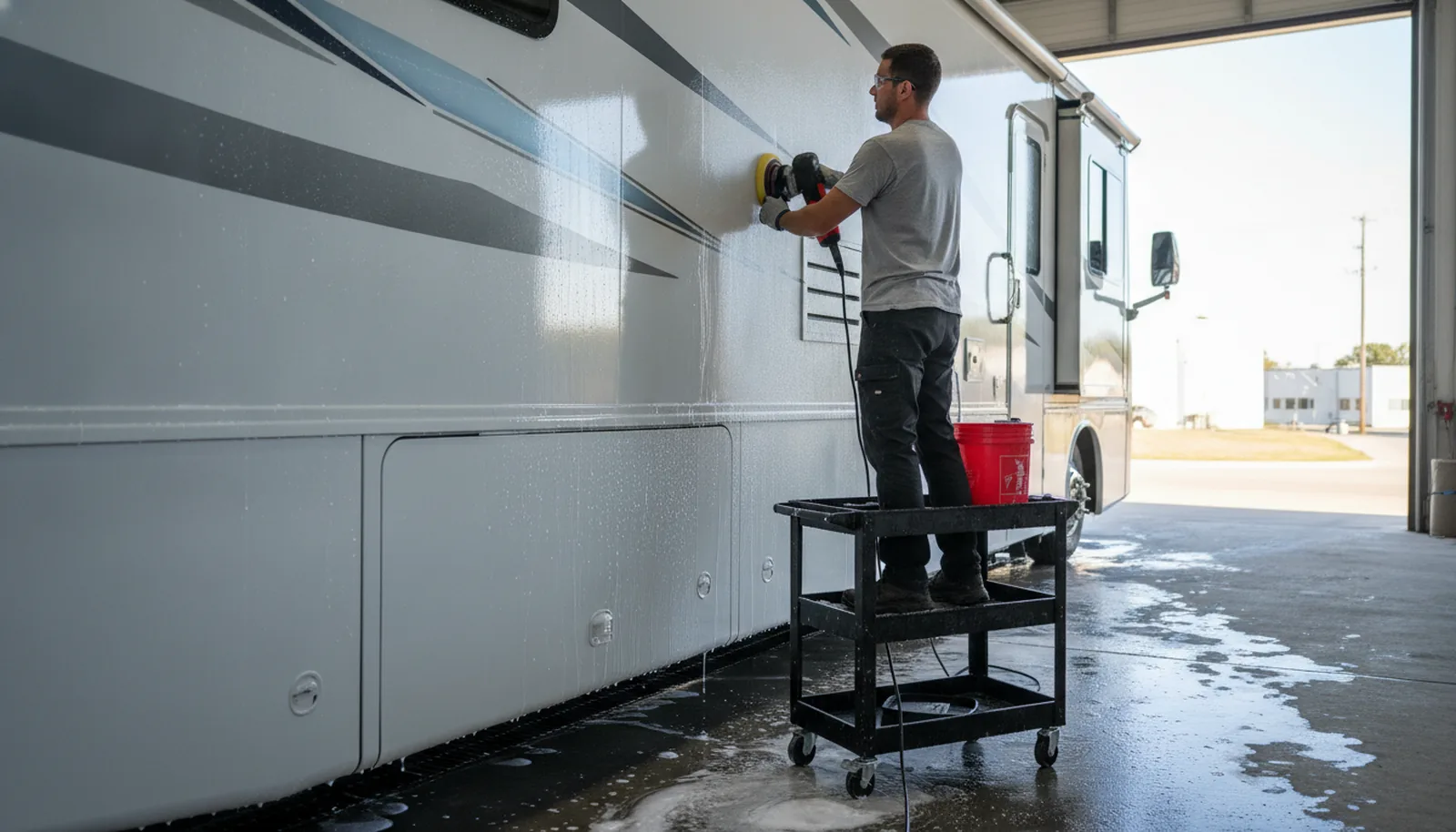
Last February I was waxing a 36-foot Winnebago in the owner’s driveway off Pine Ridge Road in Naples, a job I’d landed through a listing for RV wax oxidation removal across Florida. 78 degrees, not a cloud, and I’d already run two 20-foot sections of hose, set out a foam pad and cracked a fresh tub of carnauba. Owner comes out holding a Costco pack of microfiber and asks if I can knock out the whole coach by the afternoon, which is a common question for RV detailing in Jacksonville. I told him the same thing I tell everybody who asks how to wax an RV, and the same thing you’ll see on any page about RV wax oxidation removal by state and city: I can do abotu a panel every ten minutes or so, depending on the panel. Your coach has a lot of panels. Do the math. That math is why the RV detailing in Jacksonville crews send two guys to a big coach, and why my old marina boss always said thin coats and two peopel, or you’re just polishing your own mistakes.
Gulf Coast sun does not mess around. Same sun that eats gelcoat down in the Keys and up in the Panhandle, and it’s why RV detailers across Florida stay busy from February through May and then again in October. If you’re near Orlando or Fort Myers and your rig has started to go chalky, the RV wax oxidation removal in Orlando and Fort Myers shops will quote you per foot, and the number that comes back will make you want to do it yourself.
First, figure out which finish you have and what it needs
Knowing your finish tells you if you’re waxing or wasting a Saturday. Most RVs are either gelcoat (fiberglass sidewalls and caps) or full-body paint with clear coat. Gelcoat oxidizes; paint doesn’t much but clear coat fails.
If the towel comes up white or your color looks faded and cloudy, read the RV oxidation removal guide before buying wax.
Second thing you need to know is your surface’s heat tolerance. You cant wax a panel that feels hot to the back of your hand. On a Florida afternoon, a dark grey lower panel can get too hot to touch. That melts the wax solvent into the finish and leaves a haze that won’t buff off. So I start at first light, or after the shadows move accross the side I’m working. If you’re in a park with no shade, the only honest answer is to pay someone who has a thatched canopy or a covered wash bay. Compare quotes from mobile RV washers and detailers near you before you give up a whole weekend on a ladder in the sun.
Wash and decontaminate: the step nobody wants to do
Skip this step and you’re just waxing dirt into the finish. You can’t wax over dirt, salt, bug guts, or black streaks.
Black streaks off the rain gutters need a dedicated cleaner before you even think about wax.
Dry the rig with a squeegee or a clean microfiber. Water spots left under wax become permanent. If you’re near salt air like I am in Naples, a final rinse with a spot-free garden sprayer changes the whole job.
Pick the right protection: cleaner wax, carnauba, or sealant
The right choice comes down to how long you want it to last and how much shine you’re chasing. Three choices, one right answer for your rig.
Straight carnauba gives the warmest shine and lasts roughly one to four months in sun.
Decals and graphics: only use a non-solvent, non-abrasive wax or a dedicated vinyl protectant. Check the pH between 3 and 11, like the film maker’s care sheet says. Skip the edge of every decal with a half-inch of bare finger towel or you’ll build wax lines you’ll regret.
How to wax an RV panel by panel, in the shade
Treat the rig like a grid and you won’t miss a spot or double-wax a panel. The job breaks into panels: each sidewall about 4 feet wide, the front cap split in two, the rear cap, and the side of each slide-out.
Work in a patch about 2 feet square.
Let the wax haze for five to ten minutes, then wipe it off with a clean, dry microfiber, folding to a fresh face often.
If you use a dual-action polisher, keep the speed low for wax application.
By hand this job can take a full day or more on a 30-foot rig.
Never let wax touch rubber seals, window gaskets, or the EPDM rubber roof. If you have a fiberglass roof, you can wax it, but then walking on it becomes a skating rink. I only wax a roof if the owner asks twice and signs off on the risk.
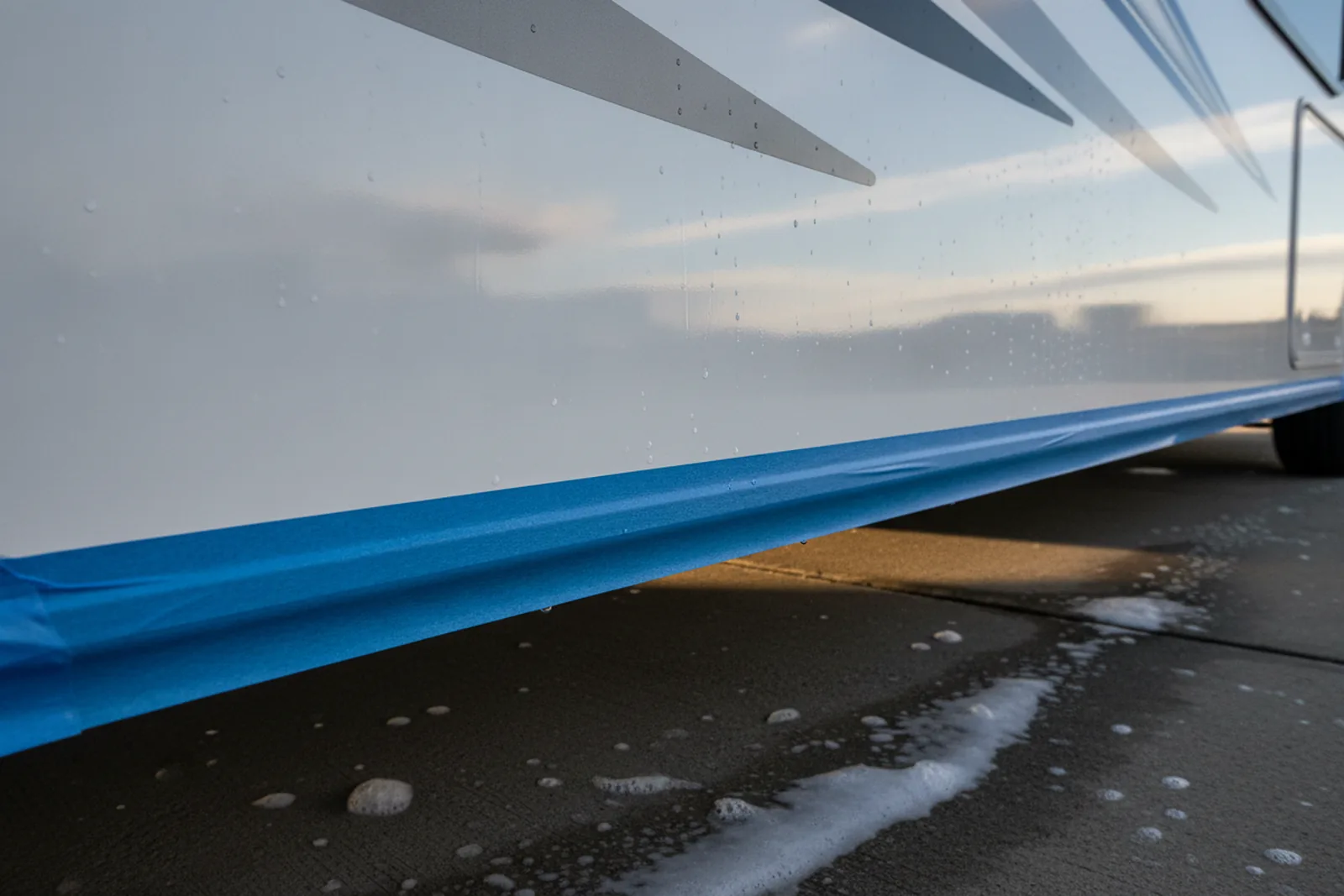
This video shows the panel-by-panel method in action on a big motorhome.
Printable checklist: waxing my RV without missing a panel
Print this and tape it to the ladder. 11. After all panels are done, walk the rig with a bright light. Look for haze, wax splatter on decals or seals, and missed spots. Total time: varies widely depending on rig length and crew size. Cost: depends on the products you choose, but expect to spend a fair amount on supplies.
The hidden failure point is the ladder. A 25-foot Class C has a roof that’s a long way up, and a fifth wheel’s sidewall is steeper than you think. Put the ladder on concrete or plywood, tie it off to a roof rack or awning arm if you can, and never lean out past your belt buckle. I’ve caught two friends mid-fall, and I won’t wax a customer’s roof without a walking board under me.
What a wax job should cost if you hire it out
A fair wash-and-wax quote runs about $10 to $16 per foot. Most mobile RV washers quote per foot.
If your rig needs compound and polish first, shops in Central Florida quote $15 a foot for light oxidation and $30 and up for real correction. That’s the RV wax oxidation removal pricing you’d see across the state.
I’ve paid a mobile detailer twice in thirteen years. Once on a rainy February when my own coach sat at a storage lot with no hookups, and once when a customer’s 43-foot Entegra needed a wash and wax before I could get to it. Both times the crew of two finished in a reasonable amount of time. If you hire, ask if their price includes the roof and decals, and ask for a written per-foot quote before they start.
When to skip wax and call a pro
There are three times I tell people to put the wax back in the cabinet.
First, if the rig has a full-body paint finish under three months old. That’s a compound and polish job, offen with multiple passes, and on a tall wall it’s faster to hire a crew with a lift.
Think of it in boat terms. In the yard, we’d compound a hull with a wool pad and rotary, then switch to foam for polish, then a finishing pad for wax. If your RV needs all that, you’re not waxing. You’re restoring, and there’s a reason RV oxidation removal by state and city is its own line item.
The ten-dollar test that tells you whether to wax or restore
Here’s a cheap test I learned from a canvas guy in Fort Myers Beach.
That test has saved me from quoting a cheap wax job when a customer needed a full correction, and it’s saved customers from paying for correction when a good coat of sealant was all they needed.
Then pull up the detailers near you. Pick two with real phone numbers, call them, and ask for a written per-foot quote on the same job: wash, wax and a note on what they’d charge to correct any oxidation they find. The quotes won’t match, and the one who asks about your roof material and your decals is the one worth paying.
Related reading
FAQ
Can I wax my RV in direct sunlight?
No. Wax solvent flashes too fast on a hot panel and leaves a haze that won't buff out. Work in shade or when the surface is cool to the back of your hand. In Florida that means early morning or after the sun moves off the side you're working. A panel that feels hot will fail every time.
How long does RV wax last?
Carnauba wax lasts one to four months in outdoor storage, less if you wash with strong detergent. A synthetic sealant lasts three to six months. Sun, salt air and frequent washing all shorten those numbers. Reapply when water stops beading or the shine dulls in patches.
Can I wax over oxidized gelcoat?
No. Oxidation is dead, chalky gelcoat. Wax over it seals in the damage and fails in weeks. Do the towel test: white chalk on a rag means compound and polish first. Our sister post on RV oxidation removal covers the whole process and when to hire it out.
Is it safe to wax RV decals?
Only with a non-abrasive, non-solvent wax or vinyl protectant. Never use a cleaner wax on clear-coated decals becuase the abrasive mars the surface. Keep wax half an inch from decal edges, and check the vinyl care bulletins for pH limits between 3 and 11.
How much does it cost to have someone wax my RV?
Most detailers charge $10 to $16 per foot for wash and wax, so a 30-foot rig runs $300 to $480. If oxidation needs correction first, add $15 to $30 per foot or more. Get written quotes from two local mobile detailers and ask if the price includes roof and decals.
Can I wax a rubber RV roof?
Never. EPDM and TPO rubber roofs are not waxable. Wax and most protectants degrade the membrane and can void it's warranty. Clean rubber roofs quarterly with a manufacturer-approved cleaner and a brush. A fiberglass roof can be waxed, but it gets dangerously slick to walk on.
How long does it take to hand wax a travel trailer?
A 25-foot travel trailer takes four to six hours by hand if you're methodical, longer if you're learning. A 35-foot fifth wheel can take ten hours over a weekend. Two people with a dual-action polisher cut that in half. My panel budget is one panel per ten minutes, and I don't rush the caps.
Find RV detailers near you
Compare RV detailers and mobile washes in your city, then ask a few for a price.
Browse by stateOr jump to: RV wax & oxidation removal · Phoenix, AZ · Roseville, CA · Kansas City, MO